Stellar Crown (SV07) Chase Cards Ranked
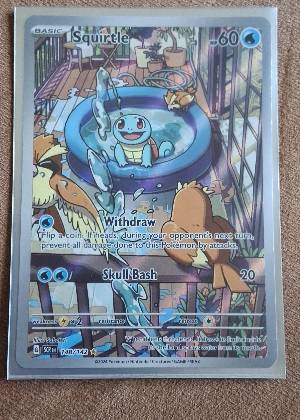
SV07: Stellar Crown is twelve months old, and its two biggest secret rares, a special illustration Squirtle at $111.59 and a special illustration Bulbasaur at $102.72, still sit above $100 raw. A price floor that survives a year of supply normalization is not a hype artifact; it is collector demand. Below is the full Stellar Crown chase table as of September 21, 2026, grading risk by card, and which ones the submission math cannot support.
The Set
Stellar Crown released September 13, 2024, as the seventh main expansion in the Scarlet and Violet era. Terapagos ex is the featured Legendary on the box. The base Terapagos ex card trades at $0.97 market right now, which tells you how the set's headline chase landed after twelve months of opening product.
The set runs 142 cards in the base checklist with 33 secrets numbered 143/142 through 175/142, for 175 cards total across the master set. Source: Serebii English set list, fetched September 21, 2026. The real value is concentrated in a small group of special illustration variants, two of them first-generation starters, that carry price premiums independent of competitive play.
Price Table (September 21, 2026)
| Card | Number | Market |
|---|---|---|
| Squirtle | 148/142 | $111.59 |
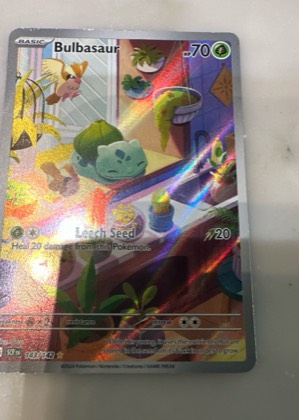
| Bulbasaur | 143/142 | $102.72 |
| Hydrapple ex | 167/142 | $37.29 |
| Milcery | 152/142 | $18.66 |
| Galvantula ex | 168/142 | $18.22 |
| Lacey | 172/142 | $17.80 |
| Zeraora | 151/142 | $13.10 |
| Terapagos ex (gold) | 173/142 | $11.84 |
| Meditite | 153/142 | $8.76 |
| Joltik | 150/142 | $7.77 |
| Crispin | 164/142 | $6.05 |
Prices from ZeroPop catalog, September 21, 2026.
Why Squirtle and Bulbasaur Hold at $100
The two most expensive Stellar Crown cards are not Legendaries or ex Pokemon. They are unevolved first-generation starters that never change their competitive status and never lose their collector appeal. Squirtle 148/142 and Bulbasaur 143/142 held above $100 through twelve months of supply hitting the market because the people buying them are not tracking set rotation or tournament results. They want a beautiful card of a Pokemon they grew up with. That demand does not decay the way hype-driven prices do.
Both sit at the right level for grading math. At $100 to $112 raw, a PSA 10 at three to four times raw runs $300 to $450, which covers any submission tier. The question is whether your specific copy will grade out.
Squirtle 148/142 has a wide illustration field, which tolerates minor surface prints better than tight-cropped cards but makes centering drift immediately visible. Bulbasaur 143/142 crops closer to the bottom frame edge; top-to-bottom centering past 60/40 reads as a defect at a glance. Centering is the primary axis on both cards. Surface is secondary. Corners and edges follow standard SV-era expectations.
Scan before you submit. A PSA 10 on these cards is worth three to four submission fees. A PSA 9 is worth slightly more than raw. Do not pay a grading company to tell you your copy is not gem mint.
Hydrapple ex at $37.29
Hydrapple ex at 167/142 is the only other Stellar Crown card where the grading math works cleanly. At $37, even a two-times-raw PSA 10 would return $74, clearing a mid-tier submission fee with room. Hydrapple is a new evolution line introduced in the Paldea region, and its special illustration treatment at 167/142 is in the upper-numbered range of the secrets, typically reserved for full alternate art cards.
The illustration has a dense green field in the background. Large green fields in SV-era cards catch print lines under raking light that disappear under direct overhead inspection. Surface is the axis to screen before submitting. If your ZeroPop scan returns a surface subgrade of 9.0 or better, the case for submitting is strong. Below 9.0 on surface, call it a raw sale at $37.
The $13 to $19 Tier
Four cards cluster between $13 and $19: Milcery (152/142) at $18.66, Galvantula ex (168/142) at $18.22, Lacey (172/142) at $17.80, and Zeraora (151/142) at $13.10.
None of these make easy grading decisions. At $18, a PSA 10 needs to clear $50 to $55 just to recover a standard submission fee and postage. That requires the card to achieve a multiple of three or higher, which happens, but only on genuinely gem copies. Scan first, and if any subgrade comes back below 9.5, sell raw.
Lacey 172/142 is the most grading-sensitive of the four. Trainer SIRs in SV sets have a consistent centering problem: the character art crops close to the inner frame edges on both sides, and any left-to-right drift past 55/45 is obvious. The centering check matters more here than the surface check.
Galvantula ex 168/142 is a foil ex card, which means the surface inspection needs to happen at multiple light angles before committing. Rotate through overhead, left raking, and right raking. Foil cards photograph defects differently under different light; what looks clean under overhead light can show texture breaks under low-angle inspection.
Free · No account
Grade your first card free.
No account, no download, no waiting. Photograph the front and the back and get all four sub-grades back in about a minute.
or get the app


The Gold Terapagos ex at $11.84
At $11.84, the 173/142 gold foil variant is a borderline submission case, visually impressive and mathematically uncomfortable. At $11.84, a grading fee consumes the entire raw value unless the card comes back PSA 10 at $35 or higher. That is achievable, but it requires a genuinely pristine pull.
Gold foil cards present one specific inspection challenge: the dense foil texture catches ambient light differently than standard holo, and corner whitening can look like a printing artifact under certain angles. Inspect all four corners under raking light from two directions before deciding. If the ZeroPop scan rates it 9.5 or above on all four subgrades, submit. Below that, $12 raw is the better outcome.
Cards to Skip
The base Terapagos ex at $0.97 is the obvious case. Greninja ex at $1.19 is the same story. No grading tier returns a profit on a sub-$2 raw card.
The harder skip is the $7 to $9 range. Meditite 153/142 at $8.76 and Joltik 150/142 at $7.77 sit in an uncomfortable middle zone where the card is not worthless but the grading fee exceeds the probable PSA 10 premium. A PSA 10 on an $8 to $9 card needs to reach $25 to break even, and the secondary market for SV-era middle-tier secrets has not delivered that multiple with any consistency.
Sleeve them and sell raw. This is not a close call.
Grading SV-Era Cards: The Two Axes
SV-era secret rares fail on centering and surface more than on corners or edges. The printing consistency in recent Scarlet and Violet sets is high enough that corner whitening is a minority failure mode. What sends a card from PSA 10 to PSA 9 is more often a centering read at 58/42 or a print line caught at one light angle that the submitter never checked.
Centering: measure to the inner frame border, not the outer card edge. On full-bleed illustration cards, the visible reference point is the white card edge itself. PSA 10 requires 55/45 left to right and 60/40 top to bottom. Cards that look centered by eye should be measured with a ruler or centering tool before committing, because full-bleed illustrations compress the visual margin and make off-center copies look closer to straight than they are.
Surface: rotate through at least three light angles before scanning. Overhead, low-angle left raking, low-angle right raking. SV illustration cards have large flat pastel or richly illustrated fields. Both show print lines under raking light that are invisible under direct overhead light. That is the inspection angle for a casual pack pull, which is why surface defects on SV cards often appear only after submission.
The how to grade Pokemon cards guide covers the full four-axis breakdown with examples from SV-era sets.
The ZeroPop Verdict
Grade the Squirtle and Bulbasaur on any copy that scans clean. The price is there for a meaningful PSA 10 return. Grade Hydrapple ex if surface comes back 9.0 or above. For the $17 to $19 cards, submit only genuinely gem pulls confirmed before you spend the fee. The $11.84 gold Terapagos ex gets submitted if and only if your scan rates it 9.5 across all four subgrades.
Everything below $10 is a raw sale. No exceptions.
The Pokemon cards worth grading guide walks through the break-even math by submission tier. Surging Sparks is the next set chronologically and runs the same SV-era grading logic.
Frequently Asked Questions
What are the most valuable Stellar Crown cards?
Squirtle 148/142 at $111.59 and Bulbasaur 143/142 at $102.72 are the two most expensive Stellar Crown secret rares as of September 21, 2026. Both are first-generation starters with special illustration art. The set's featured Legendary, Terapagos ex, trades near $1 in its standard base form.
Is Stellar Crown still worth grading a year after release?
For the top three cards, yes. Squirtle, Bulbasaur, and Hydrapple ex all carry raw prices where a PSA 10 multiple makes grading math work. Below $18 raw, the ROI only holds on genuinely gem-grade pulls; a PSA 9 on a $17 card comes back worth less than raw plus the submission fee.
How many cards are in Stellar Crown?
175 total: a 142-card base set and 33 secret rares numbered 143/142 through 175/142. Source: Serebii English set list, fetched September 21, 2026.
Why are Squirtle and Bulbasaur more expensive than the Terapagos ex on the box?
Supply and collector type. Terapagos ex appears in the standard base set pulls that open from every other pack; the secret rare Squirtle and Bulbasaur are far lower supply. More importantly, collectors chasing Kanto starters are buying for ownership, not for format relevance, and that demand is durable in a way that a Legendary's set-cycle hype is not.
What is the main grading risk on Stellar Crown secret rares?
Centering. Full-bleed SV illustration cards crop close to the frame edges, and PSA measures centering against the inner frame boundary, not the outer card edge. A copy that looks visually centered can measure 58/42 or worse against the actual reference point. Measure with a ruler before submitting. Surface is the second risk: inspect under three light angles, because overhead inspection misses the print line patterns that large flat illustration fields can show.
Should I grade the Terapagos ex gold variant?
Only on a pristine pull. The 173/142 gold foil variant trades at $11.84. A grading fee recovers only if the card grades PSA 10 and sells at $35 or above. Submit if your ZeroPop scan returns 9.5 or higher across all four subgrades. Below that, the raw sale is the better outcome by a margin that does not reward the risk.
Live community scans
Cards from SV07: Stellar Crown on ZeroPop
Real scans and prices from the community grade database. Tap a card for its grade population and price history, or the arrow to find it on eBay.
As an eBay Partner Network affiliate, ZeroPop may earn a commission when you buy through eBay links on this page.
Written by
Marcus ReevesLead Grading Editor, ZeroPop
Marcus has been collecting and grading trading cards since the late 1990s, with a focus on Pokemon, vintage baseball, and modern basketball. He leads ZeroPop's grading research, runs the editorial team's PSA, BGS, and CGC submission tests, and writes the cost and turnaround tracking that powers the app's ROI calculator.
Free · No account
Know your grade before you submit.
ZeroPop scans your cards and gives instant sub-grades for corners, edges, surface, and centering. PSA, BGS, and CGC estimates included. Free to start.
or get the app
Keep reading
Surging Sparks Chase Cards: What's Still Worth Grading
Surging Sparks (SV08) chase card prices 21 months later, with PSA 10 numbers for Pikachu ex, Latias ex, and Alolan Exeggutor ex, and which still pay to grade.
PokemonPaldean Fates Chase Cards: Prices and Grading Guide
Paldean Fates (January 2024, 245 cards) has a Mew ex worth $946 raw. Here are the 7 biggest chase cards, their September 2026 prices, and our grading verdict.
PokemonHow to Grade Pokemon Cards: The Complete 2026 Guide
Pokemon-specific grading guide covering holo types, centering issues, common defects, which cards to grade, and how to inspect at home.
Grading GuidesPokemon Cards Worth Grading in 2026: Top Targets
Which Pokemon cards are actually worth grading in 2026. Vintage, modern, Japanese, and Prismatic Evolutions chase cards ranked by PSA 10 ROI.