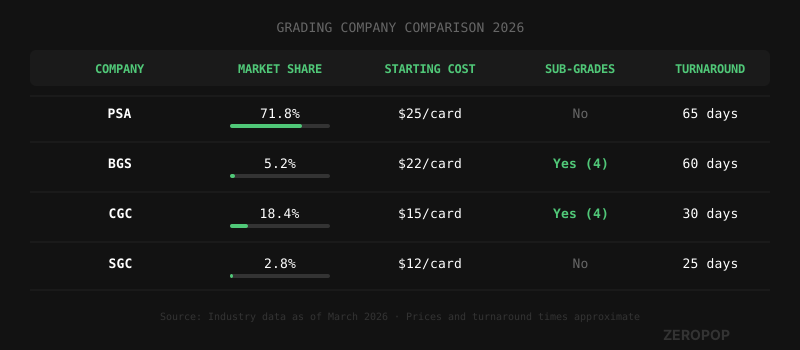
Choosing where to send your cards for grading is one of the most consequential decisions a collector makes. The company you pick determines how much your graded card is worth on the secondary market, how long you wait, how much you pay, and how the slab looks sitting in your collection.
There is no universally "best" grading company. Each has distinct strengths, weaknesses, and market positions. This guide compares PSA, BGS (Beckett Grading Services), CGC (Certified Guaranty Company), and SGC (Sportscard Guaranty) across every dimension that matters.
Company Histories
PSA (Professional Sports Authenticator)
Founded in 1991, PSA is the oldest and most dominant name in card grading. They've graded over 60 million cards and set the market standard. When someone says "graded card" without specifying a company, they almost always mean PSA. The company is owned by Collectors Universe (now Collectors Holdings) and is headquartered in Santa Ana, California.
PSA's dominance is self-reinforcing: because most collectors submit to PSA, the most sales data exists for PSA-graded cards, which makes it easier to price them, which makes buyers prefer them, which makes more collectors submit to PSA. This network effect is the primary reason PSA commands market premiums over every other grading company.
BGS (Beckett Grading Services)
Beckett has been in the card hobby since 1984 through their price guide magazines and was already a household name before launching grading services in 1999. BGS differentiated from the start by offering sub-grades - four individual scores for centering, corners, edges, and surface printed directly on the label. This transparency attracted collectors who wanted detailed condition information, not just a single number.
BGS introduced the "Black Label" designation for cards receiving a perfect 10 in all four sub-grades, and it has become one of the most coveted grades in the hobby. A BGS Black Label 10 of a high-value card routinely sells for multiples of what even a PSA 10 commands.
CGC (Certified Guaranty Company)
CGC entered the trading card market in 2020 after building a strong reputation grading comic books since 2000. Their parent company, Certified Collectibles Group, also operates NGC (coins) and CSG (sports memorabilia). CGC brought institutional grading infrastructure and professional processes honed over two decades in comics.
CGC has rapidly gained market share by offering competitive pricing, faster turnaround times, and sub-grades similar to BGS. Their slabs feature a distinctive look with a large, readable label and have improved significantly since their initial designs were criticized for being too thick and having a "comic book" aesthetic.
SGC (Sportscard Guaranty)
Founded in 1998, SGC has been around nearly as long as PSA but operates on a smaller scale. SGC built its reputation in the vintage card market, where their grading standards are particularly well-regarded. Their slab redesign in recent years - moving to a sleeker, more modern look - has helped them gain traction in the modern card market as well.
SGC positions itself as the collector's grading company: fair pricing, reasonable turnaround, consistent standards, and no drama. They lack the market premium of PSA or the sub-grade system of BGS, but many experienced collectors argue their grading consistency is the best in the industry.
Head-to-Head Comparison
| Feature | PSA | BGS | CGC | SGC |
|---|---|---|---|---|
| Founded | 1991 | 1999 | 2020 (cards) | 1998 |
| Scale | 1-10 | 1-10 (half points) | 1-10 (half points) | 1-10 (half points) |
| Sub-grades | No | Yes (4) | Yes (4) | No |
| Economy price | ~$18/card | ~$18/card | ~$15/card | ~$15/card |
| Standard turnaround | 120-150 days | 60-90 days | 30-60 days | 30-45 days |
| Express (fastest) | 2 business days | 1 business day | 5 business days | 10 business days |
| Express price | $150/card | $250/card | $65/card | $50/card |
| Minimum submission | 1 card | 1 card | 1 card | 1 card |
| Market premium | Highest | High (esp. Black Label) | Growing | Moderate |
| Best for | Resale value | Detailed grading | Speed + value | Vintage cards |
| Slab design | Classic, compact | Thick, sub-grade label | Large label, clean | Sleek, modern |
| Online population report | Yes (free) | Yes (free) | Yes (free) | Yes (free) |
| Reholder service | Yes | Yes | Yes | Yes |
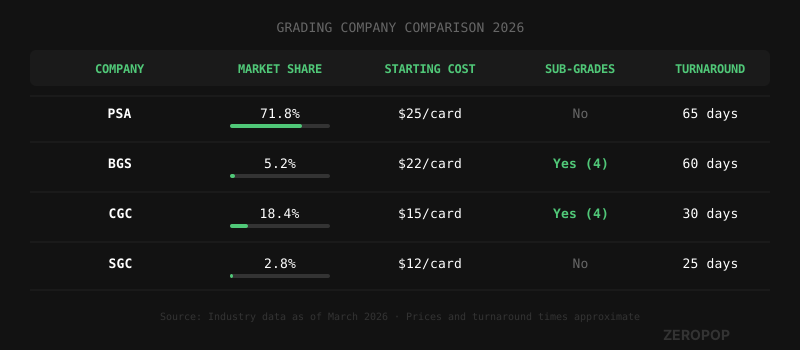
Prices and turnaround times are approximate as of March 2026 and fluctuate based on demand.
Grading Standards Compared
PSA's Approach
PSA grades on whole numbers only - there is no PSA 9.5. This binary system at the top end means a card is either a 10 (Gem Mint) or a 9 (Mint), with no middle ground. Some collectors view this as a weakness because cards that are "almost but not quite" a 10 receive the same grade as cards that barely qualify for a 9.
In practice, this means PSA 10s encompass a wider range of condition than a BGS 10 or BGS Pristine. Two PSA 10s of the same card might look noticeably different under magnification. But the market doesn't penalize this - a PSA 10 is a PSA 10, and the price reflects that.
PSA does not publish specific centering tolerances per grade, but the community has established through experience that roughly 60/40 front and 75/25 back are the outer limits for a 10.
BGS's Approach
BGS grades in half-point increments, creating a more granular scale. Their top tier is:
- BGS 10 Pristine - all four sub-grades are 10 (Black Label)
- BGS 10 Pristine - overall 10 with sub-grades of 9.5+ (at least one 10)
- BGS 9.5 Gem Mint - the standard high-end grade
- BGS 9 - Mint
The sub-grade system means two BGS 9.5 cards can look very different. One might have sub-grades of 10/9.5/9.5/9.5 and another might be 9.5/9.5/9.5/9. Both are "Gem Mint 9.5" but the former is clearly a stronger card.
BGS is generally considered stricter on centering than PSA but more lenient on corners and edges at the 9.5 level.
Free · No account
Grade your first card free.
No account, no download, no waiting. Photograph the front and the back and get the overall grade back in about a minute.
or get the app


CGC's Approach
CGC adopted the half-point system and sub-grades similar to BGS. Their top grade is CGC 10 Pristine, followed by CGC 9.5 Gem Mint. Their grading standards are comparable to BGS, though many collectors report CGC grades "looser" on centering and "tighter" on surface condition than BGS.
CGC's biggest advantage in 2026 is turnaround consistency. While PSA's economy tier can stretch past 150 days, CGC routinely hits their posted turnaround windows.
SGC's Approach
SGC uses half-point grades but does not offer sub-grades on their label. Their standards are considered very consistent - SGC graders are known for applying criteria evenly, without the variance that larger companies sometimes exhibit due to having many different graders.
SGC's grading tends to run slightly stricter than PSA at the top end. An SGC 10 is widely considered harder to achieve than a PSA 10, though the market hasn't fully priced this in yet, creating what some collectors view as a value opportunity.
Market Premiums: What Each Grade Is Actually Worth
Here's the uncomfortable truth: in most cases, a PSA-graded card sells for 10-30% more than the same card at the same grade from another company. This isn't because PSA's grading is better - it's because PSA has the deepest market, the most comps, and the strongest brand recognition.
Typical market premiums relative to raw cards (for desirable modern cards):
| Grade | PSA | BGS | CGC | SGC |
|---|---|---|---|---|
| 10 | 5-20x raw | 3-10x raw (BGS 9.5) | 2-5x raw | 2-5x raw |
| 9 | 1.5-3x raw | 1.5-2.5x raw | 1.2-2x raw | 1.2-2x raw |
| 8 | 1-1.5x raw | 1-1.3x raw | ~1x raw | ~1x raw |
| 7 or below | Often less than raw | Less than raw | Less than raw | Less than raw |
The exception: BGS Black Label 10 (perfect 10 in all four sub-grades) commands premium pricing that exceeds PSA 10 on high-value cards - often by 2-5x. This is the single highest grade in the hobby.
For vintage cards (pre-1980), SGC's market premium relative to its grading cost is arguably the best value proposition. SGC has strong credibility in vintage, and vintage collectors care more about accurate grading than brand name.
Slab Design and Display
This matters more than people admit. Cards spend most of their life being looked at, and the slab is what you see.
PSA - The classic. Compact, clear, with a color-coded label at the top. The red/blue/green label colors instantly signal the grade tier. The slab is thinner than BGS, making it better for storage density. PSA slabs fit standard slab cases.
BGS - The thickest slab in the industry. The label occupies significant real estate, and the sub-grades are printed in a horizontal strip. BGS cases are premium quality and feel substantial. The Black Label (all 10s) features a special label with distinct aesthetics. The downside: they don't fit standard PSA-sized cases.
CGC - CGC's slab has evolved significantly. The current design features a large, easy-to-read label with sub-grades displayed clearly. The case itself is well-built but slightly larger than PSA's. Their inner sleeve design has improved, though early CGC slabs had complaints about the card shifting slightly within the case.
SGC - SGC's modern slab redesign is widely praised. It's sleek, minimal, and lets the card take center stage. The tuxedo-style slab (dark borders) is popular for display. Many collectors consider it the best-looking slab on the market.
Which Company for Which Cards?
Pokemon Cards
PSA dominates the Pokemon card market. The brand recognition is unmatched, and Japanese Pokemon collectors (a massive market) overwhelmingly prefer PSA. If you're grading Pokemon for resale, PSA is the default. CGC is gaining ground in Pokemon, particularly for modern sets where their faster turnaround means you can sell closer to release hype. For Pokemon-specific grading details, see our Pokemon card grading guide.
Sports Cards (Modern)
PSA for highest resale premiums. BGS for basketball cards specifically - the basketball hobby has a long BGS tradition and Black Label basketball cards command extreme premiums. SGC is gaining traction for baseball.
Sports Cards (Vintage)
SGC is the gold standard for vintage sports cards. Their grading of pre-war and vintage cards is the most trusted in the hobby. PSA vintage grades also hold strong value, but SGC's consistency at the vintage level is unmatched.
Yu-Gi-Oh
PSA and CGC split this market. CGC has made significant inroads in Yu-Gi-Oh thanks to competitive pricing and turnaround.
Magic: The Gathering
BGS and CGC are strong in the MTG space. PSA has less penetration here, partly because the competitive MTG community historically cared less about grading.
The Cross-Grading Question
Cross-grading means cracking a slab from one company and resubmitting the card to another. Collectors do this to:
- Move from a lower-premium company (CGC, SGC) to a higher-premium one (PSA)
- Attempt a higher grade at a different company
- Convert BGS 9.5s to PSA 10s (the most common cross-grade)
The BGS 9.5 to PSA 10 pipeline is well-established. Many BGS 9.5s (particularly those with strong sub-grades like 9.5/10/9.5/10) have a realistic shot at a PSA 10, which commands a higher market price. This arbitrage opportunity exists because of the different grading scales and standards.
However, cross-grading is inherently risky. The card could receive a lower grade at the new company, and you're paying grading fees again plus the cost of a new slab.
Pre-screening with AI tools like ZeroPop before attempting a cross-grade can help you evaluate whether the sub-grade profile makes a PSA 10 realistic. If the AI assessment shows centering at the borderline of PSA's tolerances, you might save yourself the cost and risk.
Making Your Decision
If you're primarily grading for resale and want to maximize value: PSA for most cards, unless you have clear BGS Black Label candidates.
If you want the most information about your card's condition: BGS or CGC for their sub-grade breakdown.
If turnaround time matters and you want solid value: CGC or SGC for the best speed-to-cost ratio.
If you collect vintage: SGC for the most trusted vintage evaluation.
If you collect for display: Consider SGC for the most attractive slab design, or BGS for the substantial premium feel.
And if you're unsure whether to grade at all, start by reading Is My Card Worth Grading? to make sure the economics work before choosing a company.
Frequently Asked Questions
Is PSA grading better than BGS?
"Better" depends on your goal. PSA-graded cards command higher resale prices in most card categories - that's a fact driven by market dynamics, not necessarily grading quality. BGS offers sub-grades that give you more detailed condition information and their Black Label 10 is the most prestigious grade in the hobby. If you're grading to sell, PSA usually wins. If you're grading for maximum condition transparency, BGS wins.
Can I send my cards to multiple grading companies?
You can only send a given card to one company at a time, but you can submit different cards to different companies based on which one makes sense for each card. You can also cross-grade - crack a card out of one company's slab and submit it to another - though this carries risk and additional cost.
Why are PSA-graded cards worth more?
PSA's market premium comes from network effects, not necessarily superior grading. PSA has graded the most cards, so the most sales data exists for PSA grades, which makes them easiest to price. Buyers trust what they know, and sellers go where the buyers are. This self-reinforcing cycle has sustained PSA's premium position for decades.
What is a BGS Black Label?
A BGS Black Label means the card received a perfect 10.0 in all four sub-grades: centering, corners, edges, and surface. The label itself features distinctive black-background styling. Black Labels are extremely rare and represent the pinnacle of graded card condition. On high-value cards, a BGS Black Label can sell for 5-10x what a PSA 10 of the same card commands.
Which grading company has the fastest turnaround?
As of early 2026, SGC and CGC offer the fastest standard turnaround times at 30-45 and 30-60 business days respectively. For rush services, BGS offers next-business-day grading (at a steep premium), while PSA's fastest tier is 2 business days. Turnaround times fluctuate significantly based on submission volume, so always check current estimates on each company's website before submitting.
Are CGC-graded cards increasing in value?
CGC's market position has strengthened steadily since they entered the card market in 2020. The gap between CGC and PSA premiums has narrowed, and for certain categories (especially Pokemon and Yu-Gi-Oh), CGC grades are increasingly accepted by buyers. However, CGC still trails PSA and BGS in overall market premium for most card types. Whether CGC's market share continues to grow depends on their maintaining competitive turnaround and pricing as they scale.
Written by
Marcus ReevesLead Grading Editor, ZeroPop
Marcus has been collecting and grading trading cards since the late 1990s, with a focus on Pokemon, vintage baseball, and modern basketball. He leads ZeroPop's grading research, runs the editorial team's PSA, BGS, and CGC submission tests, and writes the cost and turnaround tracking that powers the app's ROI calculator.
Free · No account
Know your grade before you submit.
ZeroPop scans your cards and gives instant sub-grades for corners, edges, surface, and centering. PSA, BGS, and CGC estimates included. Free to start.
or get the app
Keep reading
The Complete Guide to Card Grading in 2026
Everything you need to know about card grading: sub-grades, grading companies, the process, costs, and when to grade (or skip it).
Grading Costs & PricingPSA Grading Cost 2026: What Every Open Tier Charges Now
PSA grading costs in 2026 after the Value tier pause: the $79.99 Regular floor, Express at $149.99, hidden shipping fees, and the real break-even math.
Grading Costs & PricingCheapest Card Grading Services 2026 (Under $10/Card)
The cheapest card grading in 2026, with PSA, Beckett and TAG budget tiers all paused. CGC $17 bulk, AGS $15, SGC, and what each really costs per card.