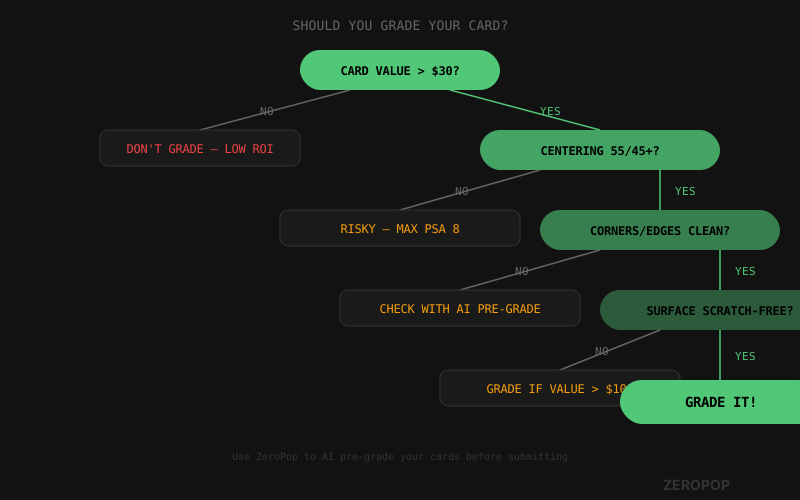
The most expensive mistake in card collecting isn't buying a fake - it's grading cards that shouldn't be graded. Every year, millions of cards get submitted to PSA, BGS, CGC, and SGC that come back in slabs worth less than the cost of grading them. The fees, shipping, insurance, and months of waiting add up to a net loss for the collector.
This isn't because grading is a scam. It's because most people skip the math. They see a card they love, imagine a PSA 10 label on it, and ship it off without calculating whether the numbers work even in the best-case scenario - let alone the realistic one.
This guide gives you a practical framework for making grading decisions. No hype, no "always grade everything" cheerleading. Just the math, the common traps, and a clear process for deciding before you spend a cent.
The Break-Even Calculation
Before anything else, you need to answer one question: If this card comes back at the grade I realistically expect, will the graded value exceed my total cost?
Here's the formula:
Graded Value at Expected Grade - (Raw Value + Grading Fee + Shipping + Insurance) = Profit or Loss
Let's work through a real example.
You have a Scarlet & Violet Illustration Rare that sells for $80 raw. You inspect it carefully and believe it's a strong PSA 9 candidate with a shot at a 10. Here's the math:
If it comes back a PSA 10:
- PSA 10 sells for: $250 (check completed eBay sales, not listings)
- Your cost: $80 (card value) + $18 (economy grading) + $12 (shipping both ways) + $0 (insurance on declared value) = $110
- Profit: $250 - $110 = $140 profit
If it comes back a PSA 9:
- PSA 9 sells for: $100
- Your cost: $110
- Profit: $100 - $110 = $10 loss
If it comes back a PSA 8:
- PSA 8 sells for: $75
- Your cost: $110
- Profit: $75 - $110 = $35 loss
Now the real question: what's the probability of each outcome? If you estimate 30% chance of a 10, 50% chance of a 9, and 20% chance of an 8, the expected value is:
(0.30 x $140) + (0.50 x -$10) + (0.20 x -$35) = $42 - $5 - $7 = $30 expected profit
That's a positive expected value - grading makes sense for this card, even though you'll lose money 70% of the time. The 10s pay for the 9s and 8s.
But change the numbers slightly. If the card is worth $30 raw and the PSA 10 sells for $60:
If it comes back a 10: $60 - ($30 + $18 + $12) = $0 (break-even) If it comes back a 9: $35 - $60 = -$25
At best you break even, and the most likely outcome is a loss. This card is not worth grading.
The PSA 9 Trap
The PSA 9 trap is the single most common way collectors lose money on grading. Here's how it works:
- Collector sees a card worth $40 raw
- Collector looks up PSA 10 price: $200. Wow, 5x multiplier!
- Collector submits the card, imagining the 10
- Card comes back a PSA 9
- PSA 9 sells for $50
- After $30+ in grading costs, the collector has spent $70+ and has a card worth $50
The trap is that the PSA 10 premium is what makes grading look attractive, but the PSA 9 premium is what you're most likely to actually receive. For most modern cards, the PSA 9 premium over raw is modest - often 15-30%. That's not enough to cover grading costs unless the raw card is already worth significant money.
The rule of thumb: If the PSA 9 price doesn't at least cover your total grading cost (raw value + fees + shipping), you're gambling entirely on the 10. That's fine if you've done the probability math and the expected value is positive. But most people don't do the math - they just imagine the 10.
Centering: The Number One Eliminator
Before you calculate expected values, check centering. It's the fastest way to disqualify a card from PSA 10 contention and the most reliable thing to evaluate at home.
Here's why centering is the great eliminator:
- It's objective and measurable - unlike surface scratches or corner wear that require judgment, centering is geometry. Either the borders are within tolerance or they aren't.
- It's visible without magnification - you can spot bad centering from arm's length.
- It's not fixable - you can't improve centering without illegal trimming.
- It's the most common failure mode - for many sets, centering problems are more prevalent than corner, edge, or surface issues.
PSA's centering tolerance for a 10 is approximately 60/40 on the front and 75/25 on the back. If your card's centering is worse than that on either side, a PSA 10 is impossible. Full stop. Don't waste time inspecting corners and edges - the centering alone kills the submission.
This is where ZeroPop provides its most concrete value. The app measures front and back centering from photos and gives you exact ratios. Centering measurement is the one area where AI analysis is genuinely more accurate than human eyeballing, because it's a purely geometric calculation that benefits from precise measurement rather than subjective judgment.
Cards That Commonly Lose Money When Graded
Certain categories of cards have a negative expected value for grading almost universally. Save your money on these:
Modern Commons, Uncommons, and Low-Value Rares
If a card is worth less than $10 raw, grading it is almost always a loss. Even a PSA 10 of a $5 common typically sells for $10-15 - barely covering the grading cost and not accounting for your time, shipping, or the raw card's value. There are rare exceptions (iconic commons like Base Set Pikachu), but for the vast majority, don't bother.
Reverse Holographic Cards
Reverse holos have two strikes against them: the holographic surface is extremely scratch-prone (making 10s rare), and the market premium for graded reverse holos is low (because demand is limited). Unless it's a particularly valuable reverse holo variant, skip it.
Damaged or Heavily Played Cards (Modern)
Grading a modern card that will receive a PSA 7 or below is almost always a loss. The graded value at 7 or below is typically less than raw near-mint value, so you're paying $30+ to make your card worth less. The exception is vintage cards where low grades still authenticate the card.
Cards with Known Quality Control Issues
Certain sets and print runs are notorious for factory defects. Sword & Shield era Pokemon cards are plagued by print lines. If you're grading from a set known for quality issues, factor in a lower probability of hitting a 10.
High-Volume Modern Cards with Enormous PSA 10 Populations
When a card has 50,000+ copies already graded at PSA 10, supply is abundant and the 10 premium erodes over time. Check population reports before submitting. A PSA 10 with a population of 200 holds its premium far better than one with a population of 20,000.
When Grading Makes Financial Sense
Flip the script. Here are the scenarios where grading is clearly the right move:
High Raw Value + Clear Condition
If a card is worth $100+ raw and you've inspected it thoroughly with good results across all four sub-grades, the expected value math almost always works. Even at a 30% PSA 10 rate, the premium on a $100+ card typically covers the losses on the 9s.
Free · No account
Grade your first card free.
No account, no download, no waiting. Photograph the front and the back and get the overall grade back in about a minute.
or get the app


Vintage Cards with Authentication Value
For cards worth $200+ raw, grading provides authentication that buyers demand. A raw vintage card at $500 is hard to sell because buyers fear counterfeits or altered cards. The same card in a PSA slab at even a moderate grade sells quickly because the buyer trusts the authentication. Grading cost is a small percentage of the card's value.
Pack-Fresh Cards from Premium Products
Cards pulled fresh from sealed packs and immediately sleeved have the highest probability of achieving high grades. If you're opening premium product (hobby boxes, specialty sets) and pulling chase cards, grade the hits. The handling history is perfect and the fresh-pull condition maximizes your chances.
Intentional Portfolio Cards
If you're buying raw cards specifically to grade and resell - a volume play - the math changes. You can absorb the losses on 8s and 9s because you're submitting enough 10 candidates that the winners fund the losers. This requires careful pre-screening, volume (20+ cards minimum per submission to amortize shipping), and honest self-assessment of each card's condition.
Personal Significance
Sometimes grading isn't about money. Your childhood holographic Charizard, the card your kid pulled from their first pack, the rare promo you hunted for years - if the card has personal meaning, the slab provides permanent museum-quality preservation. The "ROI" is sentimental, and that's legitimate. Just don't confuse sentimental grading decisions with financial ones.
The Pre-Grading Process That Saves Money
The collectors who consistently profit from grading are the ones who reject most of their cards before submitting them. Here's the pre-grading process that separates profitable submissions from expensive mistakes.
Step 1: Market Research (5 minutes per card)
Before you even look at the card's condition, check the numbers:
- What does this card sell for raw? (Check completed eBay sales, not current listings.)
- What does a PSA 10 sell for? A PSA 9?
- What's the population at each grade?
- Does the PSA 9 premium alone cover grading costs?
If the PSA 9 scenario is a loss and the PSA 10 premium isn't extraordinary, stop here. The card isn't worth grading regardless of condition.
Step 2: Centering Screen (30 seconds per card)
Check front and back centering. If either is outside the 10 threshold (approximately 60/40 front, 75/25 back for PSA), move the card to your "don't grade" pile unless the PSA 9 math works from Step 1.
Step 3: Surface and Corner Inspection (2 minutes per card)
Under bright light and magnification, inspect the surface for scratches, print lines, and defects. Check corners for whitening and rounding. Check edges for whitening and chipping. Be honest with yourself - confirmation bias is real, and you'll want to see a 10 candidate in every card you own.
Step 4: Assign Probabilities (30 seconds per card)
Based on your inspection, estimate: what's the probability this card comes back a 10, 9, or 8? Be conservative. If you've never submitted cards before, reduce your 10 probability by half. New graders consistently overestimate their cards' condition.
Step 5: Calculate Expected Value (1 minute per card)
Using the probabilities from Step 4 and the prices from Step 1, run the expected value calculation. If it's positive, the card goes in the submission. If it's negative or break-even, it doesn't.
This five-step process sounds tedious, but it takes about 10 minutes per card and saves hundreds of dollars over blind submissions. It's the difference between grading as an investment and grading as gambling.
The AI Pre-Grading Revolution
The traditional pre-grading process relies on your own eyes, your own magnification equipment, and your own honest self-assessment. That last part - honesty - is the weakest link. Every collector thinks their cards are better than they are.
AI-powered pre-grading tools like ZeroPop remove the subjectivity. You scan a card with your phone camera and the app evaluates each sub-grade using trained models, returning a predicted grade range. The AI doesn't care that you emotionally want the card to be a 10 - it measures what it measures.
The strongest use case is centering analysis, which is pure geometry and produces the most reliable AI predictions. Surface, corner, and edge analysis are less certain because phone cameras can't replicate professional grading lights and magnification, but they still provide a useful baseline that's more objective than your hopeful eyes.
The workflow becomes:
- Scan card with AI tool
- Check the predicted grade against your market research
- If the AI assessment plus market math says "submit," submit
- If the AI flags centering issues or surface defects, trust the data and move on
This is pre-screening at scale. Instead of spending 10 minutes per card with a loupe, you spend 30 seconds scanning and get an objective assessment. For collectors with large collections evaluating dozens of potential submissions, the time savings are significant.
The Volume Strategy
Serious grading submitters treat it as a numbers game. The approach:
- Pre-screen a large batch of cards (50-100+)
- Reject 60-80% based on centering, condition, or unfavorable market math
- Submit the remaining 10-20 cards that pass all screens
- Accept that some will come back 9s or 8s - the 10s cover the losses
- Track results and refine your pre-screening over time
Your hit rate (percentage that come back at the target grade) is the key metric. Experienced submitters achieve PSA 10 rates of 40-60% on pre-screened modern cards. If your rate is below 20%, your pre-screening process needs work.
Volume also helps with cost efficiency. Shipping costs are per-package, not per-card, so a submission of 20 cards costs much less per card than submitting one card at a time. Many collectors join submission groups to pool shipping costs and access bulk pricing tiers.
When Sentimental Value Overrides the Math
The entire framework above is financial. But cards are personal. If your goal is to preserve a card that matters to you, the financial math is irrelevant. A PSA 5 slab of your dad's Mickey Mantle rookie card is priceless to your family, even though the grading fee exceeded any market premium.
The key is to be clear with yourself about which mode you're operating in. Financial grading and sentimental grading are both valid - but mixing them up (using "this card means a lot to me" to justify a bad financial decision, or refusing to grade a sentimental piece because "the math doesn't work") leads to regret either way.
A Real Decision Framework
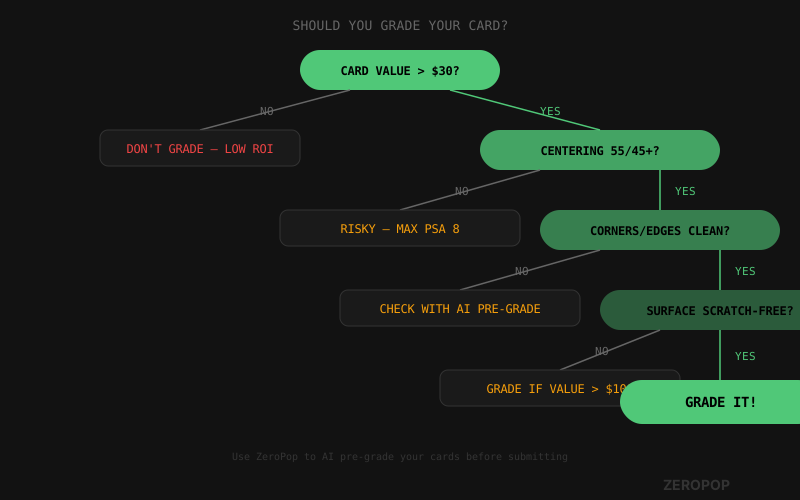
For every card you're considering grading, answer these three questions:
1. Does the math work? Calculate the expected value at realistic grade probabilities. If it's clearly positive, proceed. If it's negative, don't grade unless Question 3 overrides.
2. Is the card's condition good enough? Pre-screen with the centering check, surface inspection, corner evaluation, and edge examination. Use AI tools for objective assessment. If any factor is clearly below your target grade threshold, the card fails.
3. Does this card matter to me beyond money? If yes, consider grading for preservation regardless of the math. Just be honest that you're choosing sentiment over profit and be at peace with that.
If the answer to Question 1 is yes and Question 2 is yes, submit the card. If Question 1 is no but Question 3 is yes, submit it with clear expectations. If all three are no, the card stays raw.
This framework won't make every decision perfect - grading involves randomness and human judgment that no system eliminates. But it will keep you from making the most expensive mistake in the hobby: shipping off cards that were never worth the slab.
Frequently Asked Questions
How much does it cost to get a card graded in 2026?
Total all-in cost for economy grading at PSA is approximately $30-40 per card when you include the grading fee ($18), shipping to PSA ($8-15 depending on your location and submission size), return shipping ($5-10), and any insurance on declared value. Bulk submissions of 20+ cards reduce the per-card shipping cost. Express services add $30-130 per card on top of the base fee. For a full company-by-company cost comparison, see PSA vs BGS vs CGC.
What raw card value justifies grading?
There's no universal threshold, but as a general rule: if a card is worth less than $50 raw, you need a very high confidence in a PSA 10 and a substantial 10 premium for the math to work. Cards worth $50-100 raw are worth grading if your pre-screening suggests a strong 10 candidate. Cards worth $100+ raw are almost always worth grading if the condition supports a 9 or better, because the authentication value alone justifies the cost.
Should I grade sports cards or just Pokemon?
The grading ROI framework applies identically to all card types. Sports cards, Pokemon, Yu-Gi-Oh, Magic - the math is the same. Check the raw value, the graded premium at realistic grade levels, and your total cost. The specific market dynamics differ (PSA premiums are highest for Pokemon and sports, while BGS has pockets of strength in basketball), but the decision process is universal. Our complete grading guide covers all card types.
Is it worth grading cards I don't plan to sell?
For preservation, yes. Professional slabs provide UV protection, impact resistance, and tamper-evident sealing that no other storage option matches. If you plan to keep a card for decades, a slab protects it better than a top loader or binder page. The grade on the label is a secondary benefit - you're paying for archival-quality protection.
How do I know what grade my card will get before submitting?
You don't know for certain - grading involves human judgment and there's inherent variance. But you can estimate using thorough pre-screening: measure centering, inspect corners and edges under magnification, check surfaces under angled light, and compare your observations against the grading scale criteria. AI tools like ZeroPop provide objective pre-grade assessments from your phone camera, giving you data-driven estimates before you commit money to a submission.
What happens if my card gets a lower grade than expected?
You receive the card back in a slab with whatever grade it earned. You have several options: keep it, sell it at the graded value (which may be less than raw), crack it out of the slab and sell it raw, or crack it and resubmit hoping for a different result. Note that resubmitting the same card is risky - the grade could go down, not just up. The best strategy is to avoid this situation entirely by pre-screening rigorously before your first submission.
Written by
Marcus ReevesLead Grading Editor, ZeroPop
Marcus has been collecting and grading trading cards since the late 1990s, with a focus on Pokemon, vintage baseball, and modern basketball. He leads ZeroPop's grading research, runs the editorial team's PSA, BGS, and CGC submission tests, and writes the cost and turnaround tracking that powers the app's ROI calculator.
Free · No account
Know your grade before you submit.
ZeroPop scans your cards and gives instant sub-grades for corners, edges, surface, and centering. PSA, BGS, and CGC estimates included. Free to start.
or get the app
Keep reading
The Complete Guide to Card Grading in 2026
Everything you need to know about card grading: sub-grades, grading companies, the process, costs, and when to grade (or skip it).
Grading Costs & PricingPSA Grading Cost 2026: What Every Open Tier Charges Now
PSA grading costs in 2026 after the Value tier pause: the $79.99 Regular floor, Express at $149.99, hidden shipping fees, and the real break-even math.
Grading Costs & PricingCheapest Card Grading Services 2026 (Under $10/Card)
The cheapest card grading in 2026, with PSA, Beckett and TAG budget tiers all paused. CGC $17 bulk, AGS $15, SGC, and what each really costs per card.