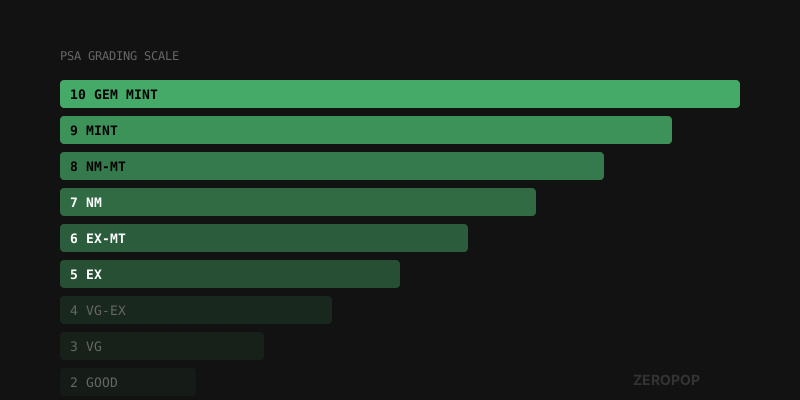
The number on a graded card's label isn't arbitrary. It maps to a specific, defined set of condition criteria that graders evaluate under professional lighting and magnification. Understanding what each grade actually means - not just the label name, but the physical reality of the card at that grade level - is essential for buying graded cards, evaluating your own cards before submission, and setting realistic expectations. PSA is the industry standard scale; BGS and CGC use their own variants, covered below alongside the qualifier system and how sub-grades combine into an overall grade.
The PSA Grading Scale: Grade by Grade
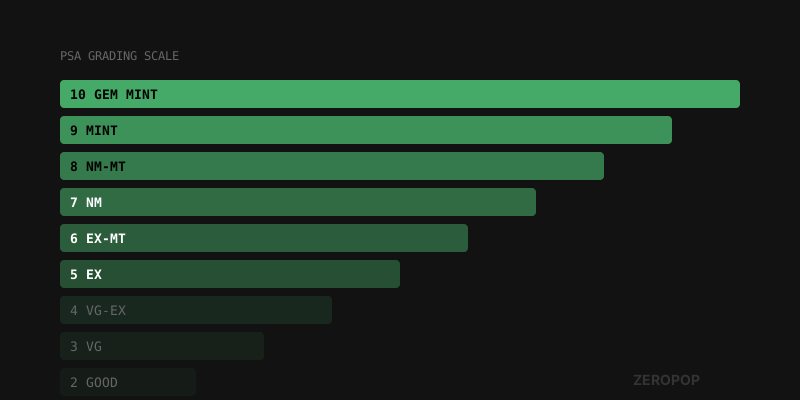
PSA uses a 1-10 whole number scale. No half points, no decimals. Each grade has an official name and specific condition requirements. The table below is the mechanical reference, corners, edges, surface, and front centering by grade; the prose after it covers what the table can't: how each grade actually plays out and what it does to the card's value.
| Grade | Corners | Edges | Surface | Front centering |
|---|---|---|---|---|
| PSA 10 Gem Mint | Zero rounding, whitening, or fiber separation under 10x magnification | No whitening, chipping, or roughness | No scratches, print lines, ink spots, or coating flaws under halogen light | ~60/40 |
| PSA 9 Mint | One corner, faintest wear, visible only under magnification | Or one small area of whitening | Or one very light scratch, visible only at certain angles | Up to ~65/35 |
| PSA 8 NM-MT | Slight wear visible to the naked eye at one or two corners | Minor whitening, often top or bottom | Light scratches visible under direct light | Up to ~70/30 |
| PSA 7 NM | Rounding on two or more corners | Whitening on multiple sections | Visible scratches or minor print defects | Up to ~75/25 |
| PSA 6 EX-MT | Rounding visible on three or four corners | Whitening on multiple edges | Minor soft creasing that doesn't break the surface | 80/20 or worse |
| PSA 5 EX | Rounding on all four corners | Consistent whitening or minor chipping | Light creases or scratches at normal viewing distance | Not the deciding factor at this level |
| PSA 4 VG-EX | Significant rounding or blunting | Wear throughout, possibly nicking or chipping | One or more creases, may break the surface | Not the deciding factor at this level |
| PSA 3 VG | Rounded or bent | Rough cuts, significant whitening or chipping | Multiple creases likely | Not the deciding factor at this level |
| PSA 2 Good | Heavy wear on all surfaces | Heavy wear on all surfaces | Heavy creasing, major staining | Not the deciding factor at this level |
| PSA 1 Poor | Major creasing or damage | Major creasing or damage | Heavy staining, possibly tape residue | Not the deciding factor at this level |
PSA 10 - Gem Mint
The pinnacle. A PSA 10 card must be virtually perfect in every measurable dimension, and that doesn't mean literally flawless under an electron microscope. It means no defects are visible under the standard examination conditions PSA uses, which includes magnification and professional lighting but not infinite magnification. Two PSA 10s of the same card can look slightly different upon close inspection, and some are "stronger" than others. The market doesn't distinguish between strong and weak 10s, but experienced collectors do.
A PSA 10 typically commands 3-20x the raw card price for desirable modern cards. For vintage cards, the multiplier can be 50x or more.
PSA 9 - Mint
One step below perfection. A PSA 9 allows one minor flaw that's visible only under close examination, per the table above. The key word is "one." A card with slight corner wear AND a surface scratch AND off-centering is more likely an 8 or lower.
PSA 9 commands a premium over raw, but significantly less than a 10. For many modern cards, the premium is modest, sometimes only 20-50% above raw, which is why the grading ROI calculation matters so much.
PSA 8 - Near Mint-Mint (NM-MT)
A very attractive card with minor but visible imperfections, the kind listed in the table above, and one that still retains a strong overall visual impression from arm's length.
This is the threshold where grading starts to hurt rather than help for most modern cards. A PSA 8 of a modern card often sells for roughly the same as a raw near-mint copy, so you've paid the grading fee for a slab that adds minimal value. Vintage cards are the exception: a PSA 8 can still command significant premiums because finding high-grade vintage cards is inherently difficult.
PSA 7 - Near Mint (NM)
A card that's been well-preserved but shows clear signs of handling or minor factory defects. Beyond the corner, edge, and surface wear in the table, a very slight wax stain or minor surface discoloration might be present.
PSA 7 typically sells at or below raw near-mint pricing for modern cards. Vintage (pre-2000) is different: PSA 7 still carries a premium because the grading authenticates the card and provides a standardized condition reference, and many vintage collectors consider it the entry point for affordable graded vintage cards.
PSA 6 - Excellent-Near Mint (EX-MT)
Noticeable wear that's visible at arm's length, but the card remains structurally sound and visually appealing. On vintage cards, this is also where light foxing (small brown spots from age) tends to show up.
PSA 5 - Excellent (EX)
Moderate wear throughout. The card has clearly been handled but is not damaged. It's still structurally intact: no tears, major creases, or delamination.
PSA 4 - Very Good-Excellent (VG-EX)
Heavy wear, but the card remains whole and displayable. The printed content is fully visible and intact even with one or more creases and moderate staining or discoloration.
PSA 3 - Very Good (VG)
A heavily played or poorly stored card, rough edges and multiple creases and all. Despite this, the card maintains structural integrity: no missing pieces, no holes, no delamination.
PSA 2 - Good
Significant damage that materially affects the card's appearance, sometimes including paper loss at the corners or edges, and a slight off-square look from cutting or warping. Still complete and identifiable, but showing its age and handling history.
PSA 1 - Poor
The lowest possible grade. A PSA 1 card is barely holding together, possibly warped, badly miscut, or substantially damaged, but it's still complete enough to be identified and authenticated, and it's still identifiable as not counterfeit.
Why PSA 1 cards exist: For many vintage cards - T206 baseball cards from 1909, for instance - even a PSA 1 is a card that's over 100 years old. The grade confirms authenticity. A PSA 1 T206 Honus Wagner is still worth six figures because the card exists and is genuine, not because it's pretty.
The BGS Scale: How It Differs
BGS (Beckett Grading Services) uses a 1-10 scale with half-point increments, creating a more granular system. The key grades are:
BGS 10 Pristine (Black Label)
All four sub-grades are 10.0. The label has a distinctive black background. This is the single hardest grade to achieve in the hobby. Fewer than 0.5% of submissions receive a Black Label. It requires absolute perfection across centering, corners, edges, and surface - with BGS's exacting standards, which are stricter than PSA's at the 10 level.
Free · No account
Grade your first card free.
No account, no download, no waiting. Photograph the front and the back and get the overall grade back in about a minute.
or get the app


BGS 10 Pristine
An overall 10 where not all sub-grades are 10. This means at least one sub-grade is 10 and the rest are 9.5+, with the combination meeting BGS's threshold for an overall 10 designation. The label has a gold background. Still extremely rare and valuable, but a tier below Black Label.
BGS 9.5 Gem Mint
The standard "high grade" for BGS. A BGS 9.5 requires sub-grades that average to 9.5, with no sub-grade below 9. Typical sub-grade combinations for a 9.5 include:
- 9.5 / 9.5 / 9.5 / 9.5
- 10 / 9.5 / 9.5 / 9
- 10 / 10 / 9.5 / 9
A BGS 9.5 is roughly equivalent to a "strong PSA 9" to "weak PSA 10" in most collectors' experience, which is why the BGS 9.5 to PSA 10 cross-grade pipeline is so common.
BGS 9 Mint
Overall 9.0. Sub-grades may range from 8.5 to 9.5 with the combination averaging to 9. This is comparable to a PSA 9.
The CGC Scale
CGC mirrors BGS's approach with half-point grades and four sub-grades (centering, corners, edges, surface). Their nomenclature:
- CGC 10 Pristine - Their highest grade, comparable to BGS Pristine
- CGC 9.5 Gem Mint - Comparable to BGS 9.5
- CGC 9 Mint - Comparable to BGS 9
CGC's population data is growing but still thinner than PSA or BGS, which can make pricing CGC-graded cards more challenging for less common cards.
Qualifiers: The Letters After the Grade
Sometimes a card receives a numerical grade plus a letter qualifier. These indicate a specific defect that the grader felt warranted calling out, even though the card's overall condition merits the numerical grade.
PSA Qualifiers
OC - Off Center The card's centering is significantly worse than what the numerical grade normally allows, but the rest of the card is strong enough that the grader assigned the higher numerical grade with the OC qualifier rather than dropping the grade entirely. A PSA 8 OC might have PSA 8 corners, edges, and surface, but PSA 5-level centering.
MC - Miscut More severe than off-center. The card's cut is dramatically misaligned - you might see part of an adjacent card on the sheet, or the card may be noticeably non-rectangular. Miscuts are sometimes collected intentionally (error collectors), but the qualifier significantly reduces market value for non-error collectors.
PD - Print Defect A visible factory printing error - heavy print lines, ink blotches, color registration errors, or missing ink. The PD qualifier tells buyers "this card has a factory defect that isn't from handling."
MK - Marked Writing, sticker residue, stamping, or other surface markings that appear to be applied after production. Common on vintage cards that were marked by their original owners.
ST - Stained Visible staining from liquid exposure, food contact, or chemical reaction. Distinct from age-related foxing.
How Qualifiers Affect Value
Qualified grades sell at a significant discount. A PSA 9 OC typically sells for roughly the same as a PSA 7 or 8 without a qualifier, depending on the card. Some collectors specifically avoid qualified grades entirely. Others - especially vintage collectors - accept qualifiers as a reality of old card stock and factor the discount into their buying decisions.
How Sub-Grades Combine Into an Overall Grade
The BGS Method
BGS's overall grade is influenced by but not a strict mathematical average of the four sub-grades. The formula is weighted and proprietary, but the community has mapped it through extensive observation:
- No sub-grade can be more than one full point below the overall grade (a card with a sub-grade of 8 cannot receive an overall 9.5).
- The lowest sub-grade acts as an anchor that pulls the overall down disproportionately.
- Corner and edge sub-grades appear to carry slightly more weight than centering in borderline cases.
Practical examples:
- Sub-grades 9.5/9.5/9.5/9 = Overall 9.5 (the single 9 doesn't pull it below 9.5)
- Sub-grades 9.5/9.5/9/9 = Overall 9 (two 9s pull the overall to 9)
- Sub-grades 10/10/9.5/8.5 = Overall 9 (the 8.5 anchors the overall)
- Sub-grades 10/10/10/9.5 = Overall 10 (all sub-grades strong enough for Pristine)
The PSA Method
PSA doesn't expose sub-grades, but their internal process follows similar logic. Graders evaluate each of the four factors and the overall grade reflects the card's weakest area more than its strongest. A card that is flawless except for a badly off-center front is not getting a 10 regardless of how perfect the other three factors are.
This is why centering is the best pre-screening tool for home evaluators. Centering can be measured objectively and precisely. If your card fails the centering check, you don't need to examine anything else - the overall grade is already capped. ZeroPop's AI grading analyzes all four sub-grades, but centering is the factor where AI measurement is most accurate because it's purely geometric.
What Each Grade Means for Your Wallet
Understanding the scale isn't just academic - it's financial. Here's how the market generally responds to each grade tier:
PSA 10 / BGS 9.5+: Premium zone. This is where grading pays for itself many times over on desirable cards. The market assigns a massive premium to top grades because they represent the best available condition.
PSA 9 / BGS 9: Modest premium. The card is worth more than raw but often not enough more to justify grading fees on cards under $50 raw value. This is the "PSA 9 trap" that many new collectors fall into - they grade hoping for a 10, get a 9, and find the graded value barely covers what they spent.
PSA 8 / BGS 8.5: Break-even or loss territory for modern cards. Grading fees often exceed the premium an 8 commands. For vintage cards, an 8 can still carry meaningful value.
PSA 7 and below: Grading typically subtracts value for modern cards (the slab costs more than it adds). For vintage cards, lower grades still provide authentication value and standardized condition reference.
This value structure is why pre-screening matters so much. If your honest evaluation of a card suggests it's a 9 rather than a 10, you need to check whether the PSA 9 premium justifies the grading cost for that specific card. For many cards, it doesn't. Our complete grading ROI analysis walks through this calculation in detail.
The Authentication Factor
Grades don't just describe condition - they authenticate identity. Every graded card is sealed in a slab with a unique certification number that can be verified online against the grading company's database. This authentication becomes increasingly important as counterfeit cards become more sophisticated.
For high-value cards (roughly $500+ raw), the authentication value of grading is significant even if the grade itself isn't a 10. A PSA 7 of a genuine $2,000 vintage card gives buyers confidence they're purchasing a real card, which is worth the grading fee regardless of the grade's impact on the resale price.
Grading companies also detect trimming (cutting cards to improve centering), recoloring (painting over whitened edges or corners), and other forms of card alteration. A card that fails an authenticity or alteration check will not receive a grade and is returned to the submitter.
Reading a Graded Card Label
Every slab label contains key information:
Card identification: The set name, year, card number, and card name. Verify this matches the actual card - mislabeled cards do exist (they're rare but they happen) and are typically worth less unless the error itself becomes collectible.
Certification number: The unique identifier. Use this to verify the card's grade on the grading company's website. This catches counterfeit slabs - fake labels on real cards, or entirely fake slabbed cards.
Population data: Some labels indicate how many copies have been graded at that grade level. This helps assess relative scarcity. A card with a population of 5,000 PSA 10s is less scarce than one with a population of 50.
Sub-grades (BGS/CGC only): Four individual scores for centering, corners, edges, and surface. These tell you exactly where the card lost points and help you evaluate whether a cross-grade to another company might yield a different overall result.
Frequently Asked Questions
What is the difference between PSA 10 and BGS 10?
A BGS 10 (Pristine) is a stricter grade than a PSA 10 (Gem Mint). BGS 10 requires near-perfect sub-grades across all four categories with tighter tolerances than PSA applies. A BGS 10 Black Label (all four sub-grades are 10.0) is the most elite grade in the hobby and commands prices that exceed PSA 10. However, a standard BGS 9.5 Gem Mint is roughly comparable to a PSA 10 in terms of card quality, though PSA 10 typically has a higher resale premium due to brand dominance.
What does "Authentic" mean on a PSA label?
PSA's "Authentic" designation (sometimes called "A" or "Auth") means the card was verified as genuine but was not graded for condition. This happens when a submitter specifically requests authentication only, or when a card has been altered in a way that disqualifies it from numerical grading but the card itself is real. Authentic-labeled cards carry authentication value but not condition value.
Can a graded card's grade change over time?
The grade on the label is permanent for that specific grading event. However, if you crack a card out of its slab and resubmit it, there's no guarantee it receives the same grade. Grading involves human judgment, and different graders may evaluate the same card slightly differently. The card's condition also cannot improve - but it can potentially worsen if mishandled during the cracking and resubmission process.
What grade do I need for a card to be worth grading?
For most modern cards, you need a PSA 10 for the grading math to work out. PSA 9 is only profitable on cards worth roughly $100+ raw where the 9-to-raw premium exceeds your total grading cost. For vintage cards, even a PSA 5-7 can add value because it provides authentication. The specific break-even depends entirely on the card - check completed sales at each grade level before you submit.
What are "population reports" and why do they matter?
Population reports are databases maintained by each grading company showing how many copies of each card have been graded at each grade level. High population (many copies at that grade) generally means lower scarcity premiums. Low population (few copies graded that high) means the card is relatively scarce in that condition, which can drive premiums up. Population reports are free to access on each company's website and are essential research before buying or selling graded cards.
Written by
Marcus ReevesLead Grading Editor, ZeroPop
Marcus has been collecting and grading trading cards since the late 1990s, with a focus on Pokemon, vintage baseball, and modern basketball. He leads ZeroPop's grading research, runs the editorial team's PSA, BGS, and CGC submission tests, and writes the cost and turnaround tracking that powers the app's ROI calculator.
Free · No account
Know your grade before you submit.
ZeroPop scans your cards and gives instant sub-grades for corners, edges, surface, and centering. PSA, BGS, and CGC estimates included. Free to start.
or get the app
Keep reading
The Complete Guide to Card Grading in 2026
Everything you need to know about card grading: sub-grades, grading companies, the process, costs, and when to grade (or skip it).
Grading Company ComparisonsPSA vs BGS vs CGC vs SGC: 2026 Grading Comparison
An honest, detailed comparison of every major card grading company (PSA, BGS, CGC, and SGC) covering cost, speed, and market value.
Grading Costs & PricingPSA Grading Cost 2026: What Every Open Tier Charges Now
PSA grading costs in 2026 after the Value tier pause: the $79.99 Regular floor, Express at $149.99, hidden shipping fees, and the real break-even math.