Card grading is the process of having a professional third party evaluate the physical condition of a trading card, assign it a numerical grade, and seal it in a tamper-evident case called a slab. That single number - typically on a 1 to 10 scale - becomes the card's permanent condition report. It tells buyers exactly what they're getting without having to inspect the card themselves.
If you collect Pokemon, sports cards, Yu-Gi-Oh, Magic: The Gathering, or any other TCG, understanding grading is no longer optional. The difference between a raw near-mint card and a PSA 10 of the same card can be 5x, 10x, or even 100x in market value. Grading has fundamentally reshaped how cards are bought, sold, and valued.
This guide covers everything from the basics of what grading actually evaluates to the step-by-step process of submitting cards, plus when grading makes financial sense and when it doesn't.
What Card Grading Actually Evaluates
Every grading company assesses the same four fundamental attributes of a card's physical condition. The terminology varies slightly between companies, but the underlying inspection is consistent.
Corners
Corners are the first thing graders check and the most common reason cards lose points. A mint card has four perfectly sharp corners with no rounding, fraying, peeling, or whitening. Under magnification, even microscopic fiber separation at the corner tip can drop a card from a 10 to a 9.
Corner wear is cumulative and irreversible. Every time a card is handled, shuffled, or shifted in a binder sleeve, the corners take micro-damage. This is why cards pulled straight from a pack and immediately sleeved have the best shot at high grades.
Edges
Edge evaluation covers the entire perimeter of the card between the corners. Graders look for whitening (where the card's core substrate shows through the printed surface), chipping, nicks, and rough cuts from the printing process. Edge wear tends to be more visible on dark-bordered cards - the white core of the cardstock contrasts sharply against a black or dark blue border.
Factory edge roughness is a real issue. Cards are cut from sheets in large batches, and some sets are notorious for inconsistent cutting. A card can come straight from a pack with edge imperfections that are nobody's fault but the printer's.
Surface
Surface condition encompasses everything on the face and back of the card between the edges. Scratches, print lines, ink spots, roller marks, surface creases, and coating inconsistencies all fall under this category. For holographic cards, surface evaluation includes the holo layer - scratches on holo foil are visible under angled light and are a significant grading factor.
Surface defects are tricky because many are invisible under normal lighting but become obvious under the halogen and LED inspection lights that grading companies use. A card that looks flawless on your desk might reveal surface scratches under professional examination.
Centering
Centering measures how well the printed image is positioned within the card's borders. Perfect centering means equal border widths on all four sides. Grading companies express centering as a ratio - for example, 60/40 means one side has 60% of the border width and the opposite side has 40%.
PSA allows up to 60/40 centering on the front and 75/25 on the back for a Gem Mint 10. BGS is stricter for a 10 but offers half-point grades that accommodate slightly off-center cards. Centering is the one condition factor that you can evaluate accurately at home with nothing more than a ruler or a digital tool like ZeroPop.
Centering is also the number one reason otherwise flawless cards fail to achieve a 10. Unlike corners, edges, and surface - which require magnification and professional lighting to evaluate - centering problems are often visible to the naked eye. This makes it the most useful pre-screening criterion before you spend money on a submission.
How Grading Companies Work
The major grading companies - PSA, BGS (Beckett), CGC, and SGC - all follow a similar workflow, though their internal processes and turnaround times differ significantly. For a detailed breakdown of each company, see our PSA vs BGS vs CGC vs SGC comparison.
The General Submission Process
- Account creation - You register on the grading company's website and select a service tier (which determines turnaround time and cost per card).
- Card preparation - You sleeve each card in a penny sleeve, then place it in a semi-rigid card holder (card saver). The card must not move freely inside the holder.
- Submission form - You fill out a form identifying each card (set name, card number, year, player/character).
- Shipping - You mail the cards to the grading company's facility with tracking and insurance.
- Receiving and intake - The company logs your submission, assigns it a tracking number, and queues it for grading.
- Grading - Professional graders evaluate each card under controlled lighting and magnification. Most companies use at least two independent graders, with a third reviewing borderline cases.
- Encapsulation - Graded cards are sealed in tamper-evident plastic cases (slabs) with a label showing the grade, card identification, and a unique certification number.
- Return shipping - The slabbed cards are shipped back to you.
Turnaround Times in 2026
Turnaround varies wildly by company and service tier. As of early 2026:
- PSA economy service runs 120-150 business days. Their express tiers (5-day, 2-day) are available but expensive.
- BGS standard is 60-90 business days. Premium same-day service exists for high-value cards.
- CGC has emerged as the fastest standard option at 30-60 business days for their economy tier.
- SGC typically runs 30-45 business days for standard submissions.
These are estimates and fluctuate based on submission volume. Holiday seasons and major set releases can double wait times.
What Grading Costs
Per-card grading costs range from roughly $15-20 for economy bulk submissions up to $150+ for premium rush services. The cost calculation matters enormously - if your card is worth $30 raw and a PSA 9 sells for $40, the $18 grading fee plus shipping both ways means you're losing money unless it comes back a 10.
We break down the full cost analysis in Is My Card Worth Grading?.
Free · No account
Grade your first card free.
No account, no download, no waiting. Photograph the front and the back and get the overall grade back in about a minute.
or get the app


The Grading Scale
Most companies grade on a 1-10 scale, but the details and nomenclature differ. Here's the universal framework:
| Grade | Condition | What It Means |
|---|---|---|
| 10 | Gem Mint | Virtually perfect in every way |
| 9 | Mint | A minor flaw, visible only under close inspection |
| 8 | Near Mint-Mint | Minor surface/corner/edge wear |
| 7 | Near Mint | Slight surface wear, minor corner rounding |
| 6 | Excellent-Near Mint | Noticeable wear on corners and edges |
| 5 | Excellent | Moderate wear, minor creasing allowed |
| 4 | Very Good-Excellent | Obvious wear, light creasing |
| 3 | Very Good | Heavy wear but still structurally sound |
| 2 | Good | Heavy damage, possible creasing/staining |
| 1 | Poor | Major damage - heavily played or damaged |
For a full breakdown of what each grade actually looks like and how sub-grades combine, see Card Grading Scale Explained.
The Four Factors That Determine Your Grade
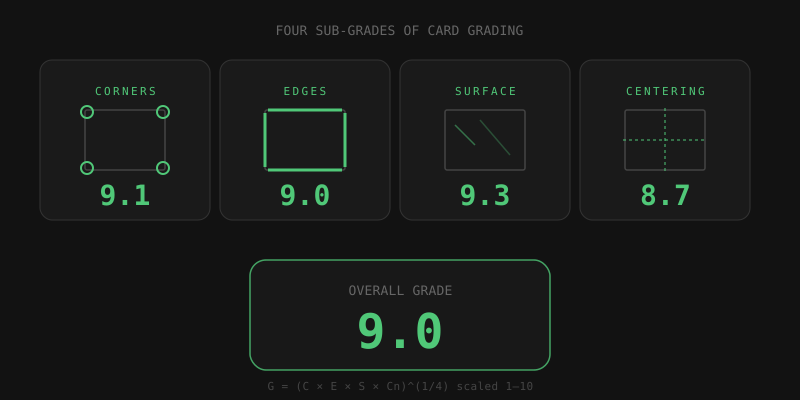
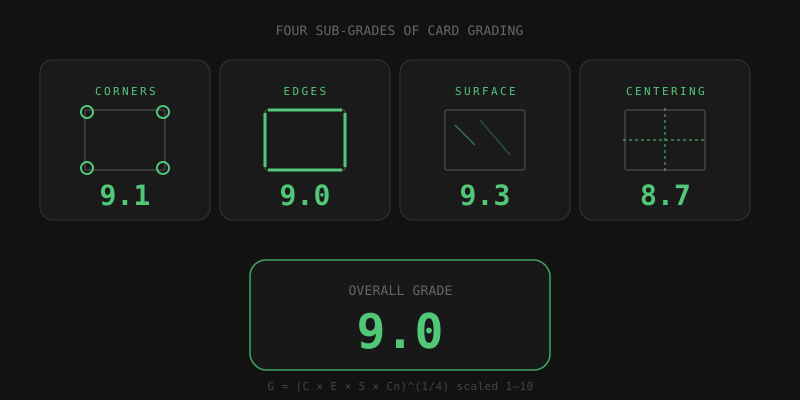
Every card's overall grade is derived from its performance across the four sub-grades: corners, edges, surface, and centering. But how these combine into a final number varies by company.
BGS is the most transparent - they print all four sub-grades on the label, and the overall grade is influenced by (but not strictly the average of) those four numbers. A BGS 9.5 Gem Mint typically requires at least three sub-grades of 9.5 or higher with none below 9.
PSA does not print sub-grades. You get a single number. Their graders evaluate all four factors but the weighting and combination formula is internal. This opacity is actually one reason PSA grades command market premiums - a PSA 10 is a PSA 10, full stop, with no sub-grade of 9 to second-guess.
CGC prints sub-grades similar to BGS, adding transparency to their evaluation.
Understanding that your card has four independent condition factors is the key to pre-screening at home. If any single factor is clearly below the threshold for the grade you want, the overall grade will suffer regardless of how strong the other three factors are.
When to Grade Your Cards
Grading makes sense when the financial math works or when preservation is the priority.
Grade when:
- The raw-to-graded price multiplier significantly exceeds the grading cost
- You're confident the card will achieve the grade needed for that multiplier (typically 9 or 10)
- You're selling a high-value card and buyers demand third-party authentication
- You want permanent archival protection for a card with personal significance
- You have volume (10+ cards) to amortize shipping costs
Don't grade when:
- The card's raw value doesn't justify the grading fee plus shipping
- The card has visible defects that will cap its grade below what adds value
- You're grading for the sake of grading rather than for financial or preservation reasons
- The card is from a set with known quality control issues that make high grades unlikely
The most common mistake new collectors make is grading everything. A $5 raw card that comes back a PSA 8 is now a $5 card in a slab that cost you $25 to obtain. Be selective.
Pre-Screening: The Smart Approach
Before committing money to a grading submission, evaluate your cards yourself. You don't need a laboratory - you need good lighting, a loupe or magnifier, and a methodical approach.
Check centering first. It's the fastest disqualifier. Hold the card at arm's length and look for obviously uneven borders. Then measure. If the centering is worse than 60/40, a PSA 10 is off the table.
Inspect corners under magnification. Use at least 10x magnification. Look at each corner from multiple angles. Any white showing, any fiber separation, any rounding - note it.
Run edges under angled light. Tilt the card slowly under a bright light source. Whitening and chipping along edges will catch the light.
Check surfaces under multiple light angles. Hold the card flat under a bright overhead light and slowly tilt it. Scratches, print lines, and surface imperfections will appear and disappear as the angle changes. For holo cards, check the holographic pattern for disruption.
This is exactly the evaluation that tools like ZeroPop automate using AI and your phone's camera. The app analyzes all four sub-grades and gives you a pre-grade assessment so you can make an informed decision about whether to submit - before spending a cent on professional grading.
The Grading Market in 2026
The card grading industry has matured significantly since the pandemic-era boom of 2020-2021. PSA remains the market leader for resale value, BGS holds its position in the basketball card and high-end Pokemon markets, and CGC has carved out a growing niche with competitive turnaround times.
Several trends are shaping grading in 2026:
- AI-assisted pre-screening is becoming mainstream. Collectors increasingly use phone-based tools to evaluate cards before submitting, reducing wasted grading fees.
- Bulk submission groups pool cards from multiple collectors to access lower per-card rates.
- Cross-grading (regrading a card from one company at another) remains common for cards that might earn a higher grade or fetch better market premiums at a different company.
- Digital verification via apps that scan slab certification numbers for authentication continues to combat the counterfeit slab market.
Common Mistakes to Avoid
Handling cards with bare hands. Oils from your skin cause surface damage that's invisible until it's under a grader's lamp. Use clean cotton gloves or handle cards by the edges only.
Using top loaders instead of card savers. Grading companies require semi-rigid card savers, not hard top loaders. Cards in top loaders will be removed and transferred, risking damage.
Ignoring the back of the card. The back is graded too. Centering, whitening, and surface condition on the reverse side count. Many collectors obsess over the front and forget to flip.
Assuming pack-fresh means Gem Mint. Modern card printing is imperfect. Cards can emerge from sealed packs with print lines, off-center cutting, factory edge nicks, and surface inconsistencies. "Pack fresh" is a starting point, not a guarantee.
Submitting without research. Check completed sales for your specific card at the grade you expect. If a PSA 9 sells for $2 more than raw, you're losing money after fees.
Frequently Asked Questions
How long does card grading take?
Turnaround times in 2026 range from 2 business days (premium rush services at PSA/BGS) to 150+ business days for economy bulk submissions. Most collectors using standard services should expect 30-90 business days depending on the company. CGC and SGC currently offer the fastest standard turnarounds.
How much does it cost to get a card graded?
Economy grading starts around $15-20 per card at most companies for bulk submissions. Express services range from $50-150 per card. You'll also pay shipping both ways plus declared value insurance. For a full cost breakdown, see Is My Card Worth Grading?.
Can I grade cards myself at home?
You can evaluate cards at home using magnification, proper lighting, and measuring tools - and AI-powered apps like ZeroPop give you a structured sub-grade assessment using your phone camera. But only submissions to recognized third-party companies (PSA, BGS, CGC, SGC) result in grades that carry market trust and resale premiums. Self-grading is for pre-screening, not for selling.
What is the best grading company?
There is no single best company - it depends on what you collect and your priorities. PSA commands the highest resale premiums for most card types. BGS sub-grades appeal to collectors who want detailed condition data. CGC offers fast turnarounds. SGC provides quality grading at competitive prices. We compare all four in detail in our grading company comparison.
Is card grading worth it for cheap cards?
Generally no. If a card is worth less than $50 raw, the grading fees, shipping, and insurance costs often exceed the value that grading adds - unless you're highly confident it's a 10 and the graded premium is substantial. Always run the math before submitting. Our guide on whether your card is worth grading walks through the break-even calculation.
What does "Gem Mint 10" actually mean?
A Gem Mint 10 means the card is virtually perfect in all four condition categories - corners, edges, surface, and centering - as evaluated under professional-grade lighting and magnification. It does not mean literally flawless at the molecular level, but it means no defects are visible under the grading company's standard examination conditions. For the full scale breakdown, see Card Grading Scale Explained.
Written by
Marcus ReevesLead Grading Editor, ZeroPop
Marcus has been collecting and grading trading cards since the late 1990s, with a focus on Pokemon, vintage baseball, and modern basketball. He leads ZeroPop's grading research, runs the editorial team's PSA, BGS, and CGC submission tests, and writes the cost and turnaround tracking that powers the app's ROI calculator.
Free · No account
Know your grade before you submit.
ZeroPop scans your cards and gives instant sub-grades for corners, edges, surface, and centering. PSA, BGS, and CGC estimates included. Free to start.
or get the app
Keep reading
PSA vs BGS vs CGC vs SGC: 2026 Grading Comparison
An honest, detailed comparison of every major card grading company (PSA, BGS, CGC, and SGC) covering cost, speed, and market value.
EducationCard Grading Scale: PSA 1 Through 10 Explained
Every grade on the PSA, BGS, and CGC scales broken down with real-world examples, qualifiers, and how sub-grades combine.
Grading GuidesIs My Card Worth Grading? The Decision Framework
A practical framework for deciding whether to grade your cards. Covers the break-even math, common traps, and the AI pre-grading approach.