Best Pokemon Card Grading App in 2026: What to Use Before You Submit
A Pokemon card grading app scans your card with your phone camera and predicts the grade PSA, BGS, or CGC would give it, before you pay a submission fee. In 2026 that fee question is sharper than it has ever been: PSA has paused every service tier under $80, so a wrong guess on a $30 card now costs you an $80 lesson. The best apps do three things a generic scanner does not: they catch silvering on dark borders, they read holo surfaces without mistaking refraction for scratches, and they run the break-even math on the submission itself.
This guide ranks the apps that actually handle Pokemon well, based on what each one catches on real cards, not on marketing pages.
Short answer: ZeroPop is the best Pokemon card grading app in 2026 if you are deciding whether to submit, because it is the only one that predicts PSA, BGS, and CGC side by side and then runs the slab-or-sell math against current grading fees. CardGrading.app is the best pure PSA predictor on the web. SnapGradeAI is a reasonable free pre-screen. CollX is a binder app, not a grader, and the official PSA app does not predict grades at all.
Why Pokemon Cards Need a Pokemon-Aware Grader
Pokemon cards fail grades in ways a generic card scanner is not tuned for.
Silvering. The single most common reason a clean-looking Pokemon card comes back PSA 9 instead of 10 is edge silvering, the white line where the front color layer does not reach the cut. It is subtle, it hides on light borders, and it screams on dark ones. An app that does not flag it is telling you a card is Gem Mint when a human grader will not. We wrote a full breakdown in the Pokemon silvering guide.
Holo and etched surfaces. Modern chase cards, the Special Illustration Rares and gold hyper rares, have textured foil that refracts light. A single flat photo reads that refraction as damage, or worse, misses a real scratch hiding in the pattern. This is why an angled second shot matters: a print line shows at an angle and disappears flat.
Centering on full-art frames. Borderless and full-art cards hide centering problems from your eye but not from PSA. You need measured ratios, not a vibe.
If the app you are considering does not address those three, it is a toy. The rankings below are ordered on exactly this.
Pokemon Grading Apps Compared
| App | PSA/BGS/CGC estimate | Catches silvering | Angled surface pass | ROI math | Free tier | Platform |
|---|---|---|---|---|---|---|
| ZeroPop | All 3 | Yes | Yes (4-angle scan) | Yes | Yes (2 scans/mo) | iOS, Android |
| CardGrading.app | PSA only | Partial | No | No | Yes | iOS, Android, web |
| SnapGradeAI | No | Partial | No | No | Yes | iOS, Android |
| CardGrader.ai | No | Yes | No | No | Freemium | iOS, Android |
| CollX | No | No | No | No | Yes | iOS, Android |
| PSA official app | No prediction | No | No | No | Yes | iOS, Android |
1. ZeroPop: Best for Deciding Whether to Submit
ZeroPop is the pick for anyone about to spend real money grading Pokemon cards. It scans the card from four angles (front flat, front angled, back flat, back angled) and returns the four sub-grades that decide everything: corners, edges, surface, centering. The angled passes exist for exactly the failure modes above: silvering on the edges and print lines in the holo that a flat photo misses. Each defect gets marked on your actual photo, so you can see whether that corner tick sits inside PSA's tolerance or is a guaranteed 9.
Then it does the thing no other Pokemon app does: the submission math. Predicted grade, estimated value at each grade tier, minus the grading fee at current 2026 prices, equals a slab-or-sell verdict. With PSA's cheapest open tier at $79.99 as of August 2026, that verdict is the difference between profit and donating $80 to PSA.
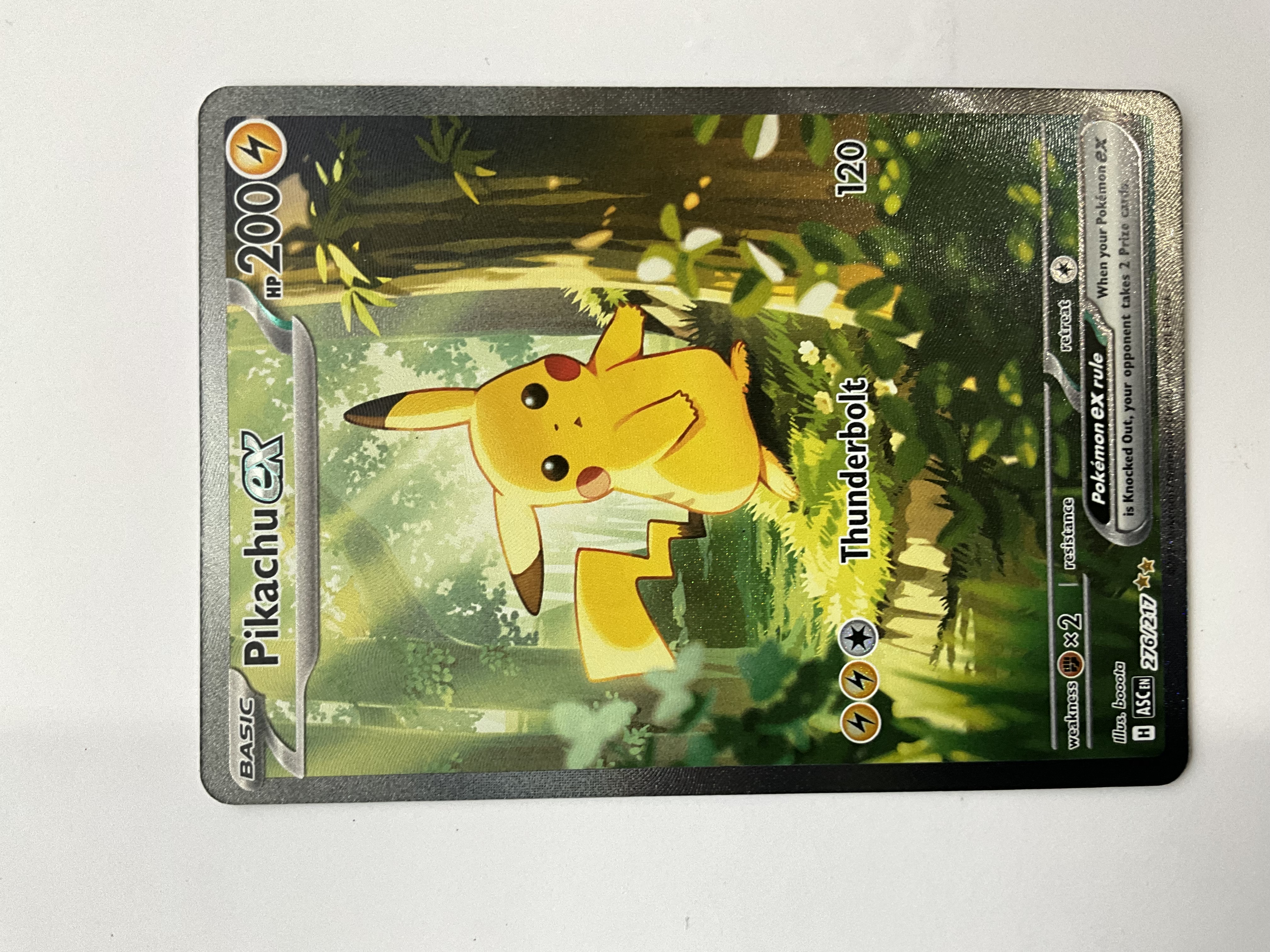
That scan above is a Pikachu ex from ME: Ascended Heroes out of the ZeroPop community feed, graded a straight 10 across corners, edges, and surface. Every card page on the site shows the community's average grade and gem rate for that exact card, which is its own kind of population report: if only 12% of scanned copies of a card hit 9.5 or better, you know the odds before you submit yours.
Pricing runs free (2 scans/month), Lite $3.99/mo, Pro $9.99/mo, Ultra $24.99/mo. The free tier's 2 scans a month is a taste, not a workflow, so heavy submitters land on Pro.
Free · No account
Grade your first card free.
No account, no download, no waiting. Photograph the front and the back and get the overall grade back in about a minute.
or get the app


2. CardGrading.app: Best Pure PSA Predictor
CardGrading.app is the fastest route to a quick PSA number from your laptop, no install. It returns a predicted PSA grade with sub-grades and centering ratios in under 30 seconds, and its PSA calibration is genuinely good on standard Pokemon stock. The web-first design is the draw: photograph on a copy stand, upload from the desktop. It's PSA only, though, so there's no read on whether BGS or CGC would treat the card better, which matters because CGC is more forgiving on micro-whitening. It also works from a single flat photo, so etched-foil surfaces are a blind spot, and there's no submission math.
3. SnapGradeAI: Best Free Pre-Screen
SnapGradeAI is built for sorting a bulk binder into "maybe" and "no" piles for free. It's TCG-led and fast, and as a first-pass filter it earns its spot: scan thirty cards from a binder, keep the handful it likes, then run those through a more serious tool. Treat its output as a screen, not a verdict. There's no multi-company estimate, sub-grade transparency is partial, and it skips the angled pass, so it shares the flat-photo blind spots.
4. CardGrader.ai: Best Sub-Grade Detail Outside ZeroPop
CardGrader.ai is the closest competitor to ZeroPop on raw grading transparency, with clean sub-grade breakdowns and honest edge detection, which suits collectors who want maximum condition detail on a single card. What it does not do is turn the grade into a decision: no PSA versus BGS versus CGC comparison and no fee math.
5. CollX: A Binder App, Not a Grader
CollX is a good free cataloging app with a huge card database, and it has been bolting on AI features. But grading prediction is not what it is for, and its condition reads on Pokemon are not in the same league as the dedicated graders. Log your collection there if you like; do not make an $80 submission decision on its output.
The Official PSA App Does Not Grade From Photos
Worth saying plainly because people search for it: the PSA app is for population reports, submission tracking, and cert verification. It will not look at your Umbreon and predict a grade. It is the companion to a submission, not the decision tool before one.
What "Accurate" Means for a Pokemon Grading App
No app, ours included, is a PSA grader in your pocket. What a good one gives you is the same information a sharp human pre-grader would: which sub-grade is the weak one, and whether the card is in the 9.5-or-better conversation at all. On ZeroPop's community data the pattern is consistent: the cards that miss Gem Mint miss on one axis, usually centering or edges, and the scan names that axis before you pay anyone.
Cards with real money on the line deserve the full workup. Evolving Skies Umbreon VMAX is the textbook case: the alternate art the hobby calls Moonbreon clears four figures graded, and the gap between a PSA 9 and a PSA 10 on it is thousands. Here is a community-scanned copy that earned its 10:
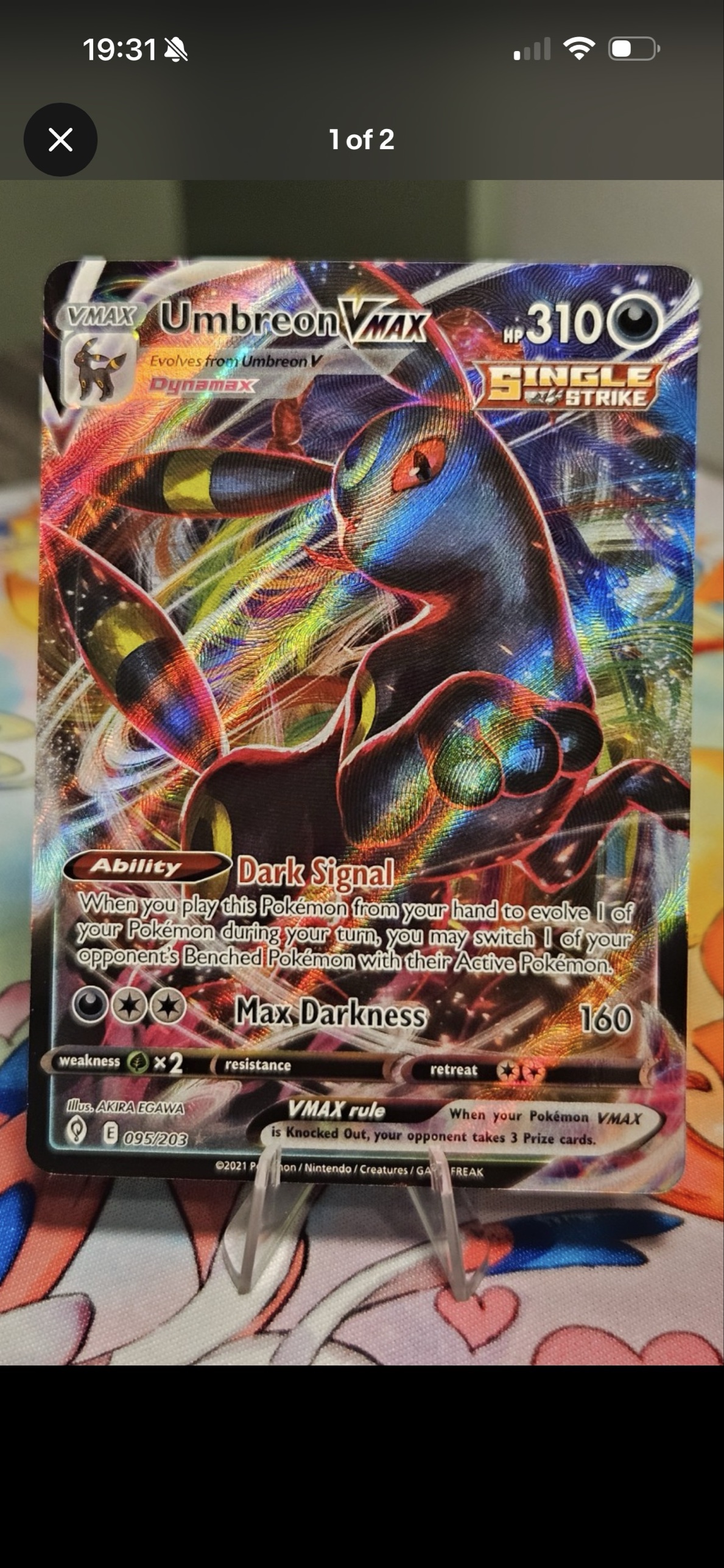
Guessing that grade from a glance is how people burn money in both directions: submitting 8s, or selling raw 10s.
For current chase sets the same logic applies at smaller numbers. The Mega Gengar ex from Ascended Heroes and the top pulls from Surging Sparks are exactly the cards where a $79.99 PSA fee only clears on a 10, so the app's job is to tell you whether a 10 is realistic on your copy.
Free Pokemon Card Grading Options in 2026
Every app in the table has some free tier, but "free" means different things. ZeroPop's free tier is 2 full scans a month with all four sub-grades. SnapGradeAI and CardGrading.app offer free scans with lighter output. ZeroPop also runs a free card grading page where you can grade one card from the browser with no account.
The honest framing: free tiers are for finding out whether the tool is right for you, and for the collector who submits twice a year. If you are prepping a 20-card PSA order, the $9.99 month of Pro costs less than one-eighth of one grading fee and can save you several.
The Submission Math, Since That Is the Point
Take a card you believe is a 9 or 10. As of August 2026, PSA's open floor is Regular at $79.99 with the Value tiers paused, CGC Bulk runs $17, and Beckett's budget tiers are sold out. So the question "is this worth grading" is really three questions: what does it sell for raw, what does it sell for at each grade, and which company's fee and turnaround fit that spread. That per-card arithmetic is what the ROI calculator does standalone, and what ZeroPop runs automatically after every scan. The full fee landscape is in the cheapest card grading service breakdown.
Frequently Asked Questions
What is the best free Pokemon card grading app?
ZeroPop's free tier gives 2 full scans a month with sub-grades, defect mapping, and grade estimates, and the website offers one free browser-based grade with no account. SnapGradeAI is a decent free bulk pre-screen. For anything with real value at stake, use a tool that shows sub-grades, because the overall number alone cannot tell you what to fix or whether to submit.
Can an app really predict a PSA grade?
Within a bounded range, yes. A good scan reliably identifies the limiting sub-grade and whether a card is in Gem Mint contention. What no app can promise is the exact final number, because human graders differ on judgment calls too. Use the prediction to decide whether to submit, not as a guarantee of the label.
Does ZeroPop work for Japanese Pokemon cards?
Yes. The scanner grades Japanese cards the same way, and Japanese stock actually grades better on average because of tighter print quality. Set identification covers Japanese releases including Black Bolt and White Flare style import sets.
What app tells me if my Pokemon card has silvering?
ZeroPop flags edge silvering as an edge defect and marks where it sits on the card, and CardGrader.ai has honest edge detection as well. Flat single-photo apps miss light silvering routinely. If you want to check by eye first, tilt the card under a strong light and look for a thin white line along the border cut.
Is it worth grading Pokemon cards under $50 in 2026?
Usually not through PSA while every tier under $80 is paused. A $40 card needs a near-certain 10 just to break even there. CGC Bulk at $17 keeps cheaper cards viable if the graded premium is real. Scan first, check the spread between raw and graded prices, and be willing to hear "sell it raw."
Which grading company should the app compare against?
All three majors, because they disagree. BGS is harshest on centering, CGC is kinder to micro-whitening, PSA carries the biggest sale premium. A card that is a PSA 9 candidate can be a CGC 9.5 candidate, and that difference changes which fee is worth paying. This is why ZeroPop shows all three estimates side by side instead of a single number.
Written by
Marcus ReevesLead Grading Editor, ZeroPop
Marcus has been collecting and grading trading cards since the late 1990s, with a focus on Pokemon, vintage baseball, and modern basketball. He leads ZeroPop's grading research, runs the editorial team's PSA, BGS, and CGC submission tests, and writes the cost and turnaround tracking that powers the app's ROI calculator.
Free · No account
Know your grade before you submit.
ZeroPop scans your cards and gives instant sub-grades for corners, edges, surface, and centering. PSA, BGS, and CGC estimates included. Free to start.
or get the app
Keep reading
Best Card Grading Apps in 2026: AI Scanners Compared
ZeroPop, CardGrading.app, Cardly AI, CardGrader, SnapGradeAI, Ludex, and CollX compared in a 2026 ranking table on accuracy, sub-grades, ROI tools, and price.
PokemonHow to Grade Pokemon Cards: The Complete 2026 Guide
Pokemon-specific grading guide covering holo types, centering issues, common defects, which cards to grade, and how to inspect at home.
Grading GuidesPokemon Card Silvering: How Much Hurts a PSA Grade
What silvering on Pokemon cards actually is, how to spot it, and how much silvering drops a card from PSA 10 to PSA 9 to PSA 8.
Grading GuidesAI vs Human Card Grading in 2026: When Each One Wins
How AI card grading apps compare to PSA, BGS, and CGC human graders in 2026. Accuracy, cost, speed, and the right time to use each one.
Grading GuidesPokemon Cards Worth Grading in 2026: Top Targets
Which Pokemon cards are actually worth grading in 2026. Vintage, modern, Japanese, and Prismatic Evolutions chase cards ranked by PSA 10 ROI.