Best Sports Card Grading Apps in 2026: Baseball, Football, Basketball
A sports card grading app photographs your card and predicts what PSA, BGS, or CGC would grade it, which in 2026 is the cheapest insurance in the hobby: PSA's open pricing floor is $79.99 per card with every Value tier paused, so pre-screening a stack before you submit is the difference between a profitable order and an expensive stack of 7s. The catch is that most "card scanner" apps are identifiers, not graders. They tell you what the card is and what it sold for, then go silent on the only question a submission depends on: what grade is this copy.
This guide separates the two. Identification apps like Ludex and CollX are genuinely useful for naming a shoebox of cards. Grading apps are a different tool, and only a couple of them handle sports cards seriously.
Short answer: ZeroPop is the best sports card grading app in 2026 for submission decisions, with sub-grades on corners, edges, surface, and centering, PSA, BGS, and CGC estimates side by side, and break-even math against real 2026 grading fees. Ludex is the best bulk identifier for sports, Cardly AI is a fast sports-first scanner without the decision layer, and CollX is the best free cataloging app. None of the last three should decide an $80 submission for you.
Identifier or Grader: Know Which One You Are Downloading
The sports card app market splits cleanly.
Identifiers answer "what is this card and what is it worth." Point the camera at a 1991 Fleer and it names the player, the set, the number, and pulls comps. Ludex and CollX are the leaders here, and for sorting an inherited collection they are exactly right.
Graders answer "what condition is this copy, and is it worth submitting." That requires measuring centering ratios, reading corner wear and edge chipping, and catching surface problems on chrome. It is a harder problem, and it is the one that decides whether you make money.
The trap is submitting off an identifier's price data alone. A raw Near Mint comp tells you nothing about whether your copy gets the 9 that price assumed. Every reseller who has eaten a batch of PSA 6s learned this the expensive way. The reseller's guide to grading covers that workflow in full.
Sports Card Apps Compared
| App | Type | Grade prediction | Sub-grades + centering | ROI math | Free tier | Best for |
|---|---|---|---|---|---|---|
| ZeroPop | Grader | PSA, BGS, CGC | Yes | Yes | Yes (2 scans/mo) | Submission decisions |
| Ludex | Identifier | No | No | No | Yes | Bulk sports ID |
| Cardly AI | Scanner | Partial | Partial | No | Yes | Fast sports scans |
| CardGrading.app | Grader | PSA only | Yes | No | Yes | Quick web checks |
| CollX | Identifier | No | No | No | Yes | Free cataloging |
| PSA official app | Companion | No | No | No | Yes | Pop reports, tracking |
1. ZeroPop: Best for Deciding What to Submit
Best for: Collectors and resellers building a PSA or CGC order and pruning it down to the cards that clear break-even.
Pricing: Free (2 scans/month), Lite $3.99/mo, Pro $9.99/mo, Ultra $24.99/mo. iOS and Android.
ZeroPop scans front and back, flat and angled, and returns the four sub-grades graders actually use. The angled pass matters more on sports cards than anywhere else: chrome and refractor surfaces hide scratches in direct light, and vintage stock hides press lines. Defects get marked on your photo so you can see exactly which corner or edge is the problem.
Then the decision layer: predicted grade, value at each grade tier, minus the fee at the tier you would use, equals submit or sell raw. With PSA at $79.99 minimum as of August 2026 and CGC Bulk at $17, the same card can be a clear no at PSA and a sensible yes at CGC. The app does that comparison per card.
It handles vintage honestly too. Here is a 1982 Topps Lawrence Taylor rookie from the community feed, scanned at a 9:
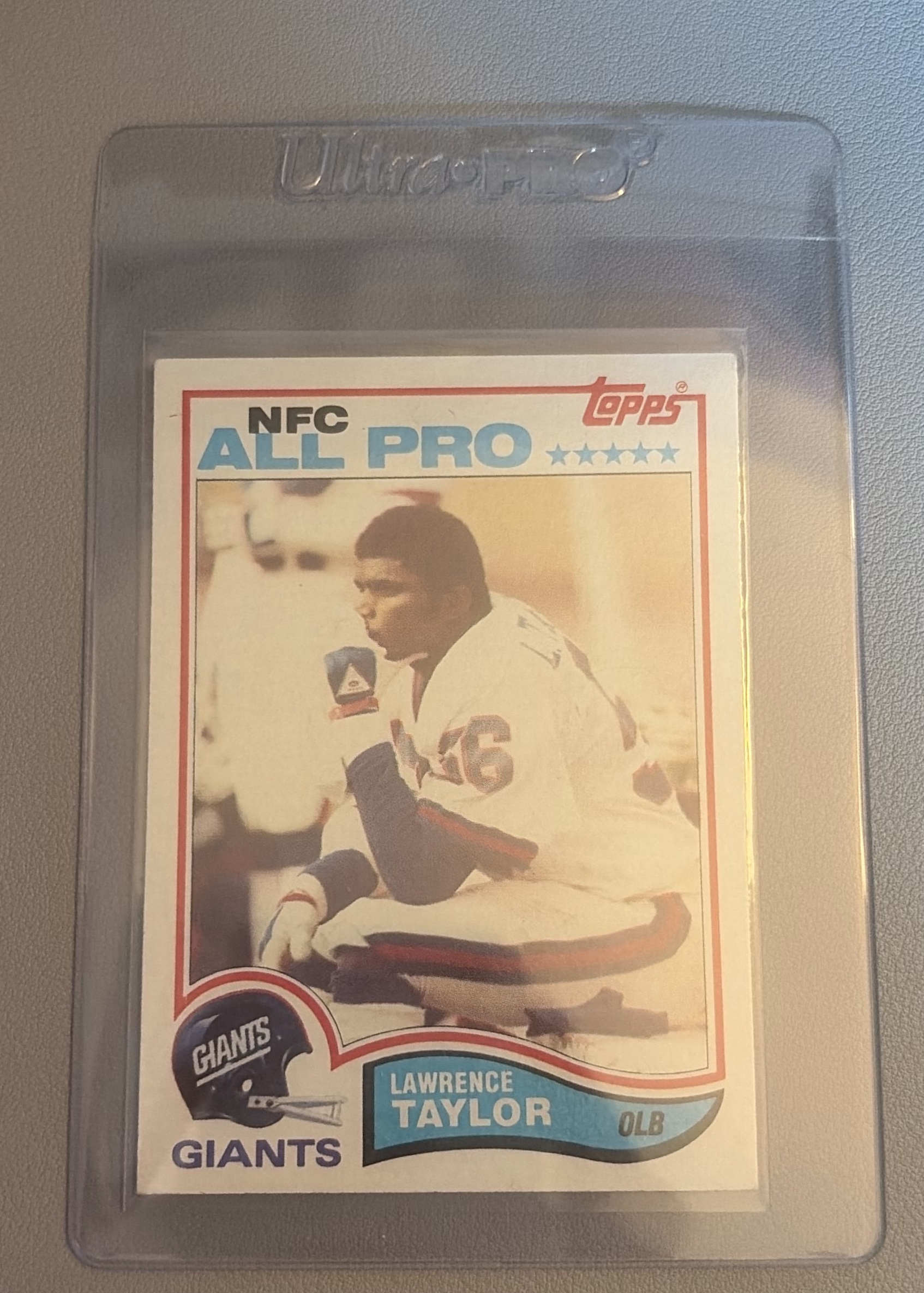
On a 44-year-old card that grade is the whole ballgame. We broke down what each grade of that card is worth in the Lawrence Taylor 1982 Topps rookie value guide, and the short version is that centering, the axis most 1982 Topps fail, moves the price by multiples. That is exactly the read you want before paying a grading fee, and you can compare your copy against the community scans on the card's own page, like this 1985 Topps Rickey Henderson or the 1991 Fleer Hardest Hitter insert.
Limitations: The 2-scan free tier is a trial, not a workflow. Sports catalog depth is strongest on the major Topps, Fleer, Upper Deck, and Panini lines; obscure regional issues may identify loosely even though the grading read is unaffected.
Free · No account
Grade your first card free.
No account, no download, no waiting. Photograph the front and the back and get the overall grade back in about a minute.
or get the app


2. Ludex: Best Bulk Sports Identifier
Best for: Naming and pricing hundreds of cards fast.
Ludex is the fastest way to turn a shoebox into a spreadsheet. Its recognition across decades of baseball, football, basketball, and hockey products is the best in the category, and its comp data is solid. Use it for triage: identify everything, sort by value, and shortlist what might be worth grading.
Limitations: Grade prediction is not its lead feature and centering precision is not in the same conversation as the dedicated graders. Ludex tells you the card is worth grading if it is Mint. It does not tell you whether yours is.
3. Cardly AI: Fast Sports Scans, Thin Decision Layer
Best for: Modern sports collectors who want quick condition reads on Panini and Topps releases.
Cardly AI is sports-first, fast, and simple, with reasonable condition reads on modern cards. As a quick filter on a stack of base and inserts it works.
Limitations: Partial sub-grades, no multi-company estimate, no fee math. Fine for screening, not for the final call on a $500 rookie.
4. CardGrading.app: Quick PSA Checks From the Desktop
CardGrading.app predicts PSA grades with sub-grades and centering ratios from a web upload, and it handles sports cards competently. If you photograph cards on a stand at a desk, the browser workflow is convenient. PSA-only output and no ROI math keep it at fourth for sports use.
5. CollX: Best Free Cataloging
CollX remains the best free way to log a collection and get ballpark values, with a massive user-scanned database. It is not a grading tool, and its condition estimates should not drive submissions. Pair it with a real grader: CollX for inventory, a grading app for the shortlist.
Where Free Actually Gets You in 2026
The query everyone types is "sports card grading app free," so here is the honest answer. Ludex and CollX are genuinely free for identification. For grading, ZeroPop gives 2 full scans a month free plus a no-account free browser grade, and CardGrading.app has free scans with lighter output.
Free identification plus free grading covers the casual case completely: name the collection, scan the two best cards, decide. The paid tiers only enter when you are running volume, and at $9.99 for 150 scans, Pro costs less than one-eighth of a single PSA fee. The math is not close if you submit even quarterly.
The 2026 Fee Reality Makes Pre-Screening Mandatory
The reason this category matters more than it did two years ago is that cheap grading is mostly gone. As of August 2026, PSA has paused every tier under the $79.99 Regular level, Beckett's $14.95 Base and $34.95 Standard tiers are sold out, and TAG's regular tiers are paused. CGC Bulk at $17 and AGS at $15 are the budget doors still open. The full landscape is in the cheapest card grading service comparison.
At those prices, submitting on hope is a losing strategy. A modern rookie needs a 10, or a strong 9 on a big name, to clear an $80 fee. The whole point of a grading app is to sort your stack into the few cards where those odds are real and the many where they are not. Run the ROI calculator on any card to see the break-even yourself.
Frequently Asked Questions
What is the best free sports card grading app?
For identification, Ludex and CollX are free and excellent. For actual grade prediction, ZeroPop's free tier gives 2 full scans a month with sub-grades and defect mapping, plus one free browser-based grade with no account. There is no unlimited-free serious grader in 2026; the compute behind a real condition read costs money.
Can an app grade baseball cards accurately?
A good one reliably identifies the limiting sub-grade, which is the decision-relevant part. Vintage baseball fails mostly on centering and corners, both of which are measurable from a proper scan. What no app guarantees is the exact final label, since human graders vary on judgment calls too. Use the prediction to filter submissions, not as a certificate.
Do grading apps work on chrome and refractor cards?
Flat single-photo apps struggle, because refractor surfaces bounce light that either hides scratches or fakes them. This is why ZeroPop shoots angled passes in addition to flat ones; surface defects on chrome show at an angle and vanish head-on. If your app grades a refractor's surface from one flat photo, treat that surface number with suspicion.
Is it worth grading sports cards under $50 in 2026?
Through PSA, almost never right now, because the $79.99 floor means even a 10 can fail to break even. Through CGC Bulk at $17, a sub-$50 card can still work if the graded premium is real and the copy is genuinely strong. Scan it, check the spread, and default to selling raw when in doubt.
Which grading company is best for vintage sports cards?
PSA carries the deepest market and the biggest price premium for vintage baseball and football, which is why most vintage submitters go there despite the fee. BGS's harsher centering standard punishes vintage stock. If the copy is borderline, a CGC grade at a third of the fee can be the smarter economics. Compare the estimates per card instead of picking one company for everything.
What should I scan first in a big collection?
Rookies of Hall of Famers and current stars, anything pre-1980 in sharp condition, and low-numbered or short-printed inserts. Identify everything with a free tool, sort by raw value, then run the top of the list through a grading scan. In most collections fewer than one card in fifty justifies a 2026 grading fee, and the scan's job is finding those fifty-to-one cards before the fee finds you.
Written by
Marcus ReevesLead Grading Editor, ZeroPop
Marcus has been collecting and grading trading cards since the late 1990s, with a focus on Pokemon, vintage baseball, and modern basketball. He leads ZeroPop's grading research, runs the editorial team's PSA, BGS, and CGC submission tests, and writes the cost and turnaround tracking that powers the app's ROI calculator.
Free · No account
Know your grade before you submit.
ZeroPop scans your cards and gives instant sub-grades for corners, edges, surface, and centering. PSA, BGS, and CGC estimates included. Free to start.
or get the app
Keep reading
Best Card Grading Apps in 2026: AI Scanners Compared
ZeroPop, CardGrading.app, Cardly AI, CardGrader, SnapGradeAI, Ludex, and CollX compared in a 2026 ranking table on accuracy, sub-grades, ROI tools, and price.
Reseller & BusinessCard Grading for Resellers: 2026 Profit Strategy
How resellers and flippers should use card grading in 2026. Submission selection, ROI math at scale, bulk strategies, and avoiding the volume trap.
Grading GuidesAI vs Human Card Grading in 2026: When Each One Wins
How AI card grading apps compare to PSA, BGS, and CGC human graders in 2026. Accuracy, cost, speed, and the right time to use each one.
Grading GuidesBest Cards to Grade in 2026: Top ROI Picks
The 12 cards most worth grading in 2026 across Pokémon, baseball, football, basketball, and MTG. Ranked by PSA 10 premium and grading-cost ROI.
Sports CardsLawrence Taylor Rookie Card: 1982 Topps Value by Grade
What the 1982 Topps Lawrence Taylor #434 rookie card is worth by grade, why it is one of the toughest PSA 10 pulls of the decade, and if grading pays in 2026.