Card Grade Examples: What Every Grade Looks Like on Real Scans
A number on a slab does not tell you why a card got that number. This guide shows a real, collector-scanned card across the grade scale, from a Gem Mint 10 Umbreon ex down to a creased 2 Mickey Mantle, each one pulled from ZeroPop's community scan history with its four sub-grades (corners, edges, surface, centering) and the exact flaw that set the overall. If you have ever looked at a graded card and wondered what actually separates a 9 from a 10, or why a mint-looking card came back lower than expected, these nine cards are the answer.
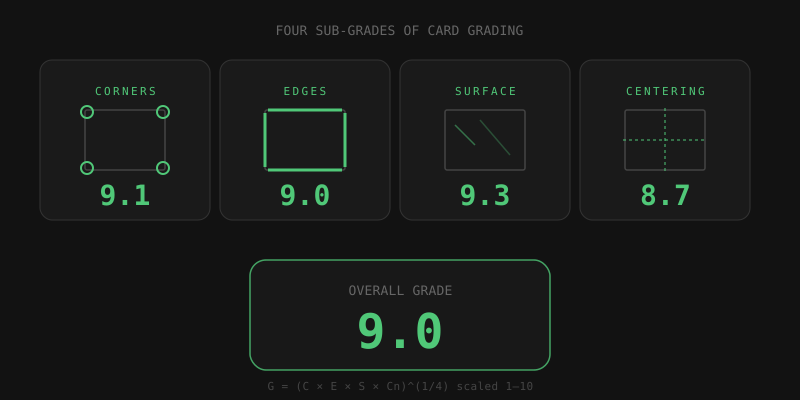
How the four sub-grades set the overall
Every major grading company, PSA, BGS, and CGC, evaluates a card across the same four axes.
Corners. Sharpness at all four tips, front and back. Whitening, fuzzing, and rounding all cost points here.
Edges. The cut along all four sides. Whitening, chipping, and roughness are the usual deductions.
Surface. The front face: scratches, print lines, stains, creases, and gloss loss. Foil and holo finishes make surface flaws easier to catch.
Centering. How evenly the image sits inside the border, measured front and back. This is the one axis that is purely geometric rather than a judgment call.
The principle that matters most, and the one collectors underestimate most often, is this: the overall grade is anchored by the weakest sub-grade. A card can have three axes sitting at a 9 or 10, but if the fourth axis is a 5, the overall is not going to land near the top of the scale. That is why a card that looks mint from arm's length can still come back with a grade that surprises you. One bad axis, whether it is a single crease, a stained patch, or four whitened corners, caps the whole card. Scanning a card before you submit it tells you which of the four axes is your weak point, before you have paid a grading fee to find out.
The grade ladder, card by card
Nine real scans, Gem Mint 10 down to a Good 2, each with its four sub-grades and the reasoning behind the number.
Gem Mint 10: Umbreon ex (Prismatic Evolutions, Moon Mirage art)
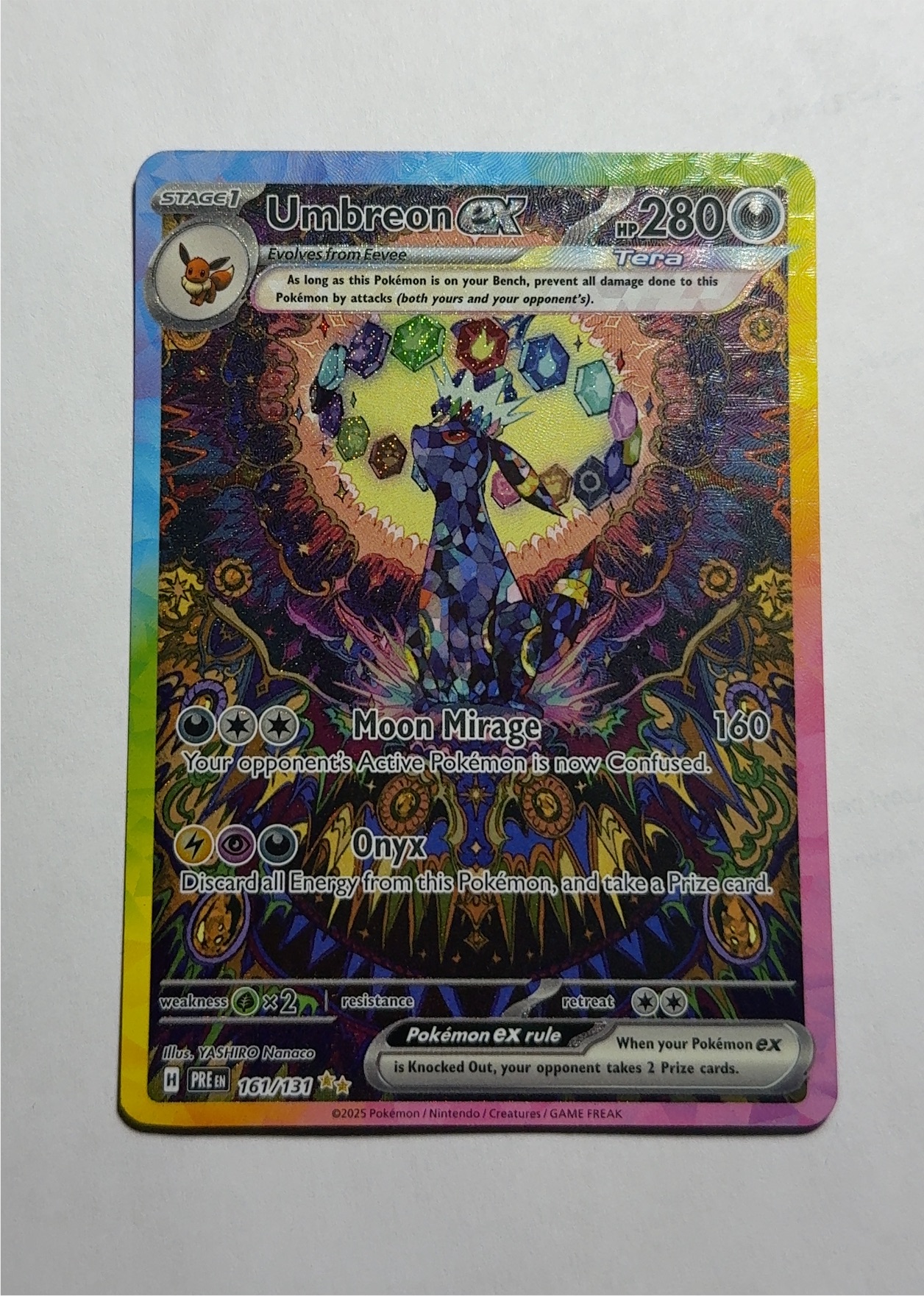
Corners 10 · Edges 10 · Surface 10 · Centering 9.5
This is what a true gem looks like. Corners, edges, and surface are all flawless, no whitening, no scratches, no print defects anywhere on the card. Centering sits at 9.5, a hair off perfect, but with every other axis maxed out, that single half-point below 10 is not enough to pull the overall down. When three axes are perfect and the fourth is nearly perfect, you get a Gem Mint 10.
Mint 9: Charles Barkley (1986-87 Fleer)
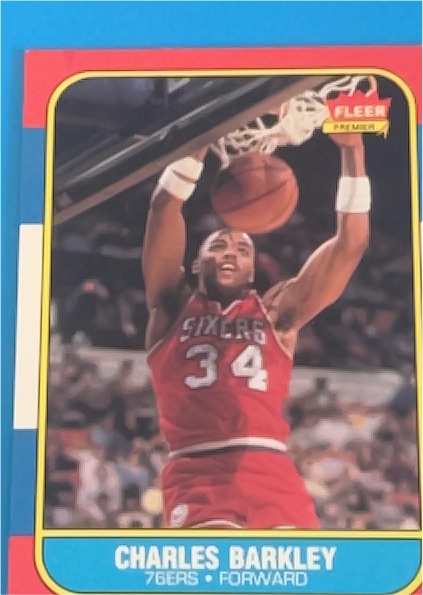
Corners 9 · Edges 9.5 · Surface 9.5 · Centering 8.5
Corners, edges, and surface are all mint level on this card. Centering is what holds it back, at 8.5, the borders are visibly off center compared to a true gem. This is the classic divider between a 9 and a 10 on a vintage card: the print quality and handling can be nearly perfect, but if the factory cut the card off center, that ceiling is set the moment it left the printing press, long before anyone touched it.
Near Mint-Mint 8: Shining Mewtwo (Neo Destiny)
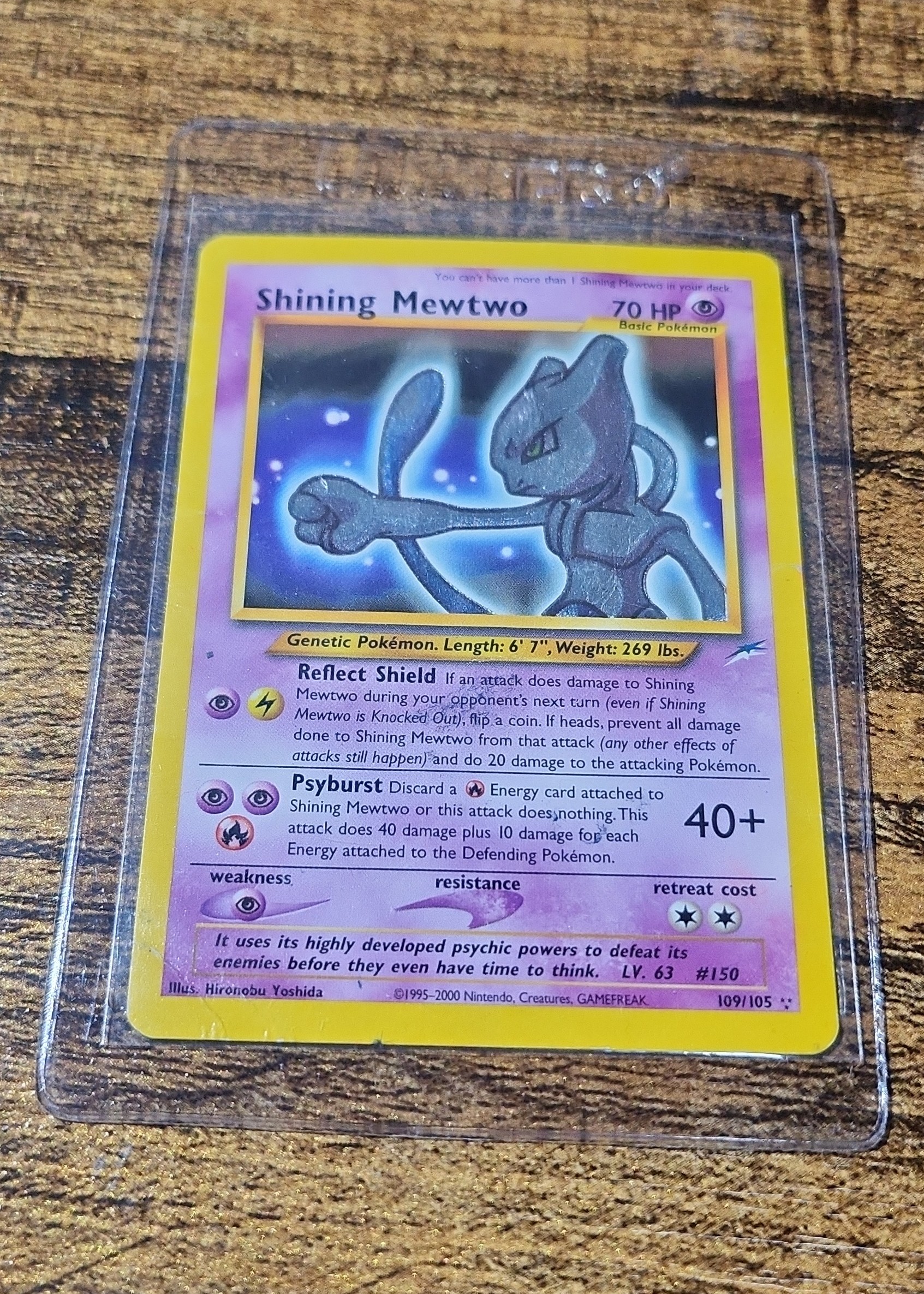
Corners 8 · Edges 8.5 · Surface 8 · Centering 9
Nothing severe is going on with this card, and that is exactly the point. There is light corner fuzzing, a touch of whitening along the top edge, and minor surface wear. Centering is actually the strongest axis here at 9. An 8 like this is not the product of one big flaw, it is several axes each sitting a notch below mint at the same time, and that adds up.
Near Mint 7: Nolan Ryan (1970 Topps)
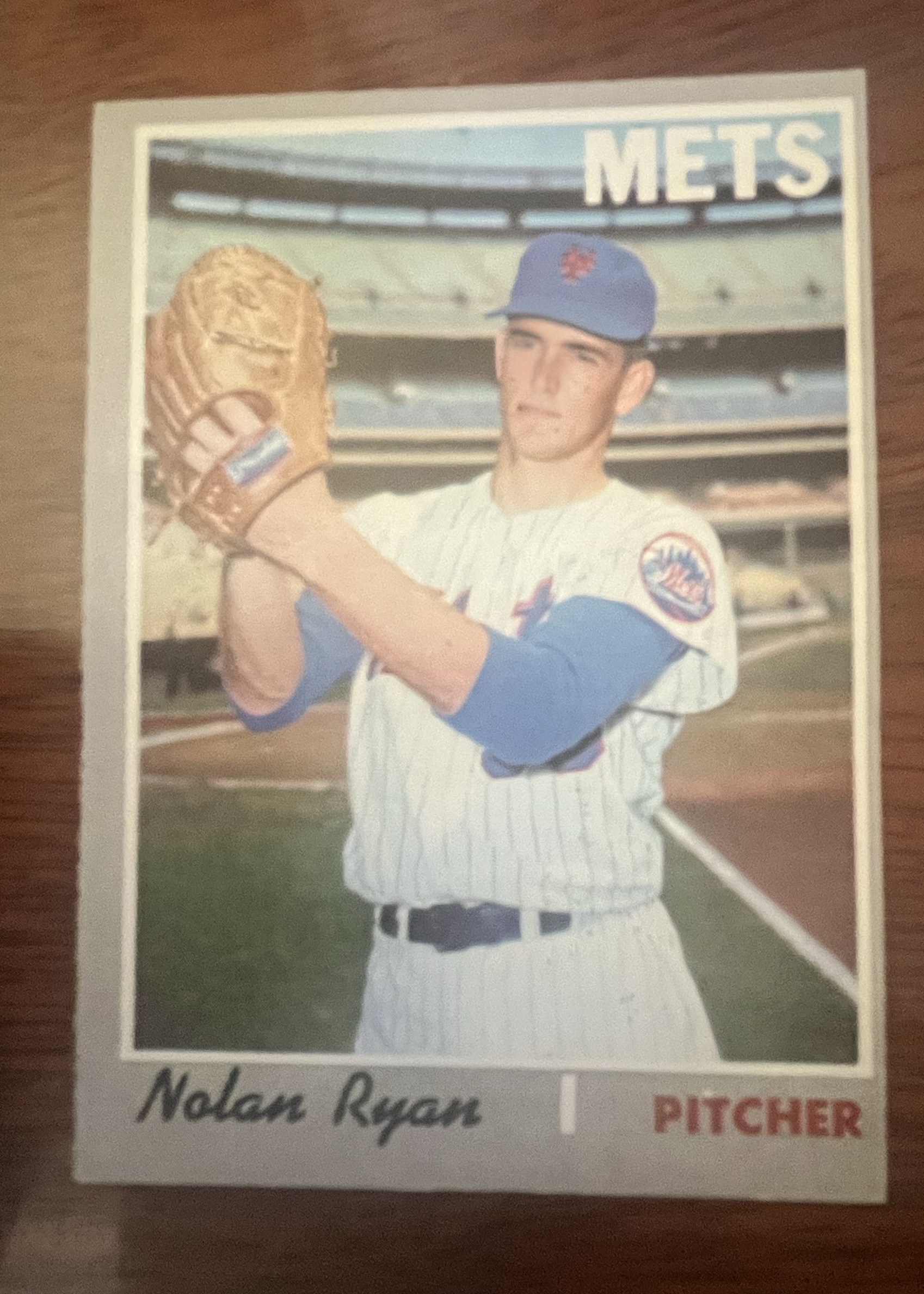
Corners 6.5 · Edges 7.5 · Surface 7.5 · Centering 8.5
All four corners on this Nolan Ryan show whitening, and that is the axis anchoring the overall at 6.5. Edges and surface both hold up noticeably better, closer to an 8. Corner whitening across all four corners is the single most common reason a vintage card that looks clean from a distance settles at a 7 instead of climbing higher.
Excellent-Mint 6: Kobe Bryant (1990s Metal Universe etched-foil insert)
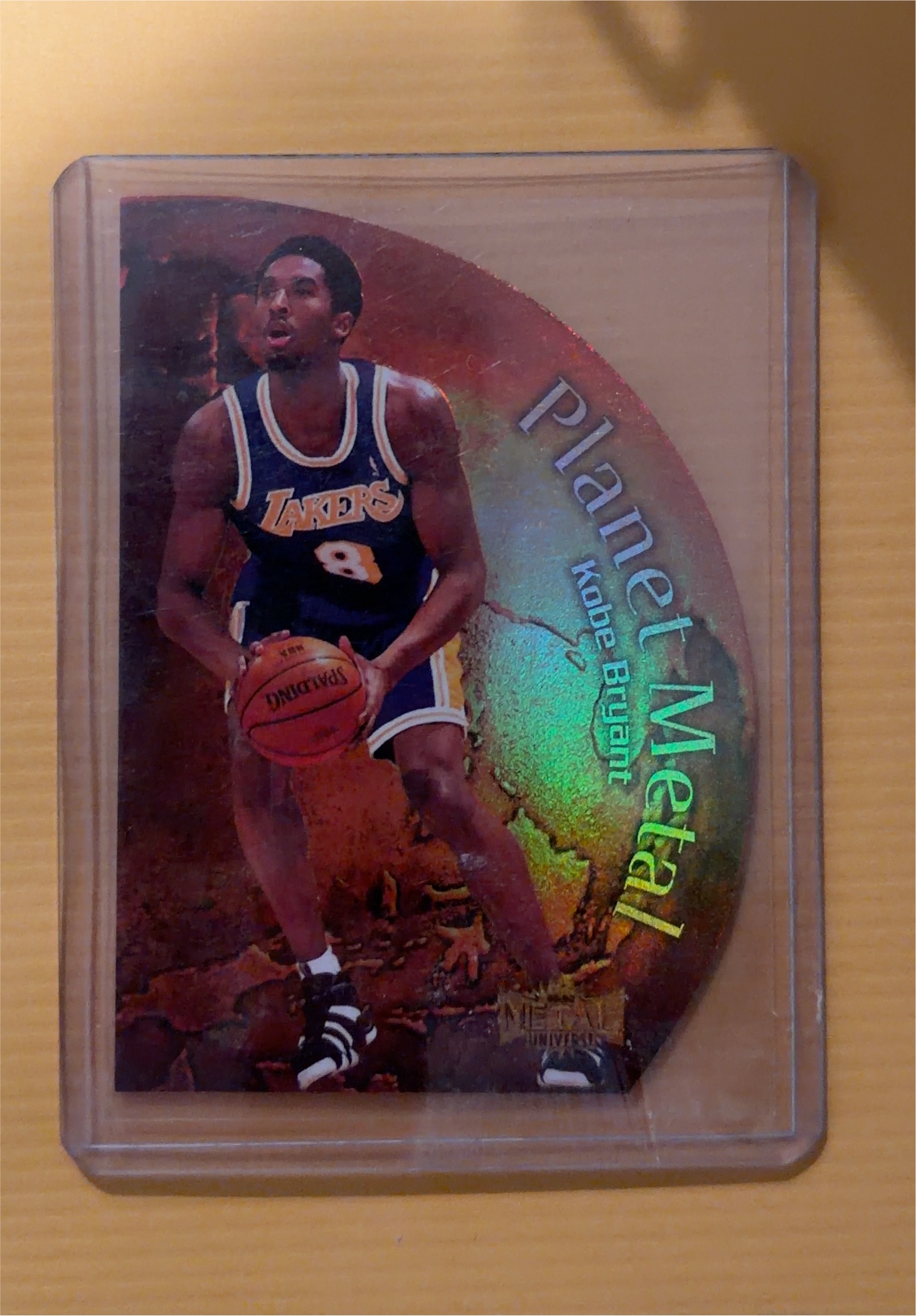
Corners 8.5 · Edges 6 · Surface 6 · Centering 8.5
The corners on this card are sharp, sitting at 8.5, and centering is strong too. But the etched-foil edges and surface both come in at 6, and those two weaker axes are what set the overall, not the sharp corners. Etched-foil inserts like this one are especially prone to edge and surface flaws from the manufacturing process itself, and sharp corners alone cannot rescue a card once those axes fall behind.
Free · No account
Grade your first card free.
No account, no download, no waiting. Photograph the front and the back and get the overall grade back in about a minute.
or get the app


Excellent 5.5: Lugia (Aquapolis)
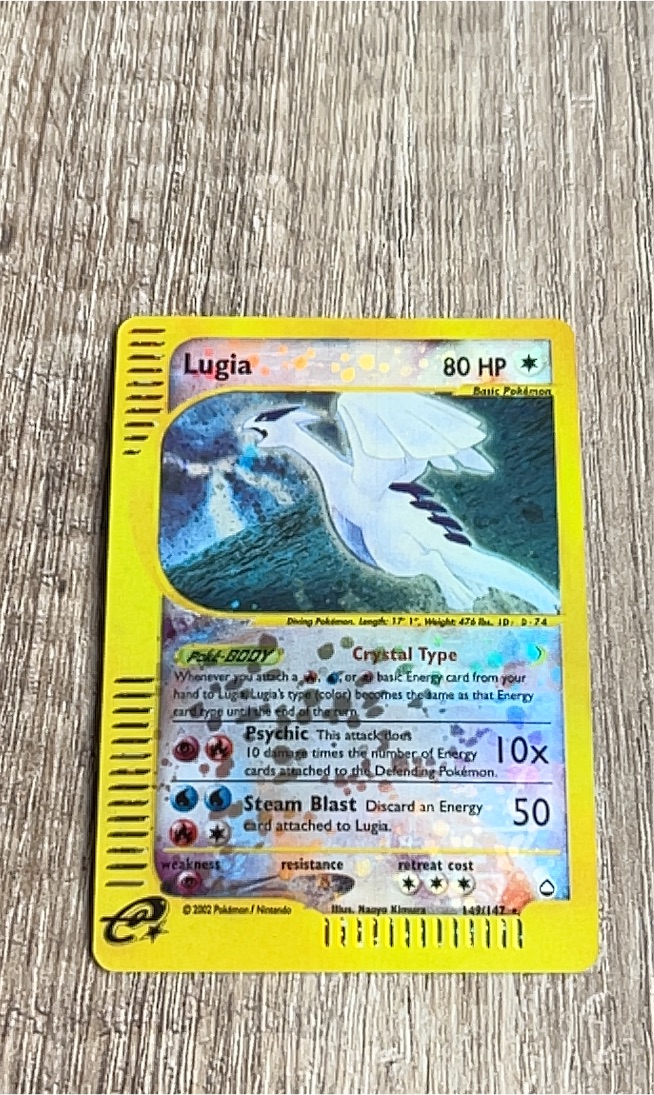
Corners 8.5 · Edges 8.5 · Surface 5 · Centering 9
This is a textbook floor case. Corners and edges are both 8.5, centering is a strong 9, and by any casual glance this card looks like it should grade well above a 5.5. But surface staining and print spots drag that one axis down to 5, and an overall grade can never climb far above its single worst axis. One bad sub-grade is enough to tank an otherwise clean card, no matter how strong the other three look.
Very Good-Excellent 4.5: Blue-Eyes White Dragon (1st Edition, Legend of Blue Eyes White Dragon)
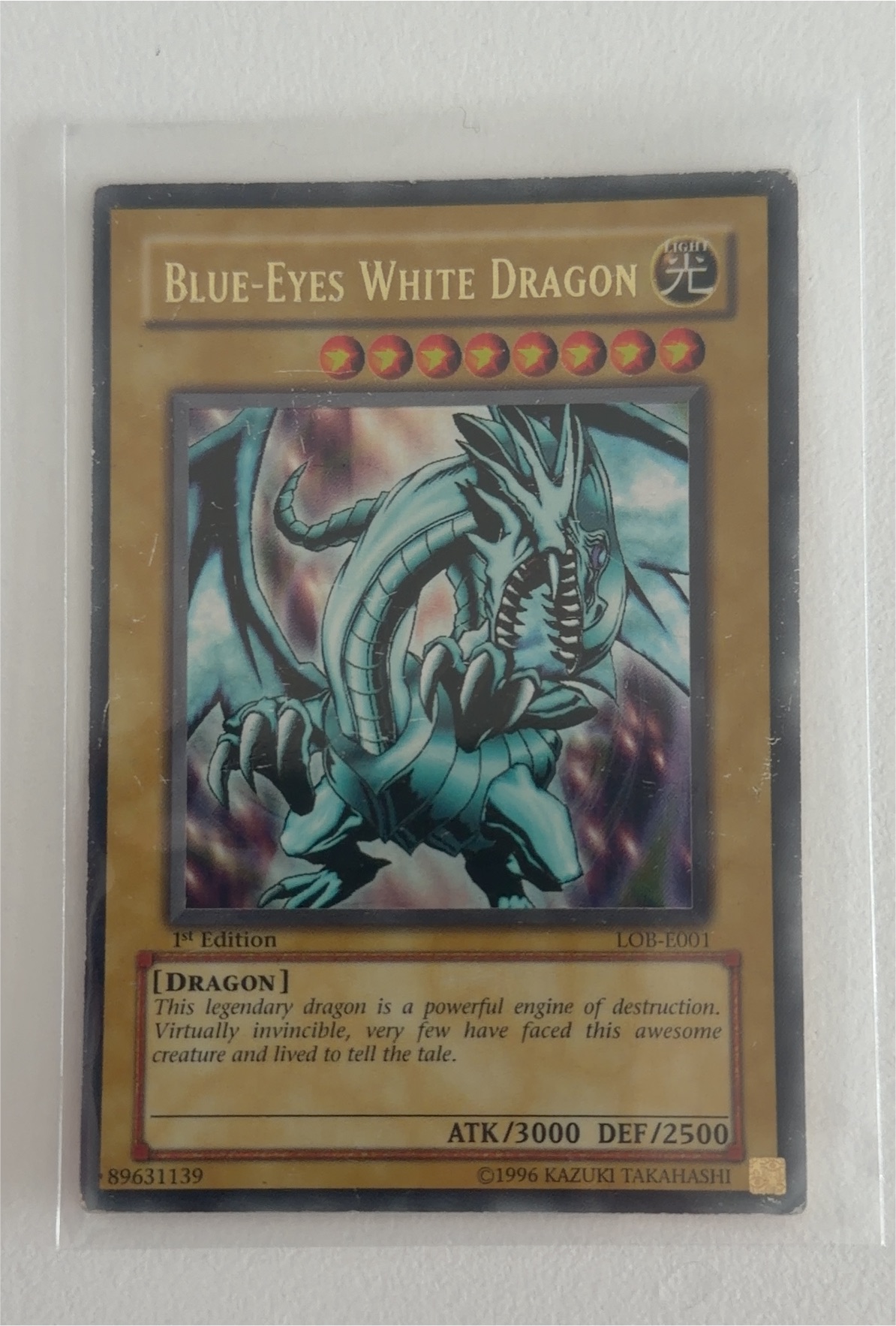
Corners 4 · Edges 4.5 · Surface 5 · Centering 5
There is no single catastrophic flaw on this card, just broad handling wear across every axis at once. Corners are fuzzy and whitened, all four edges show chipping, and the holo surface has scratches. When all four sub-grades cluster in the same range instead of one axis standing out as the weak point, the card reads as a card that has simply been played with and handled a lot over the years.
Very Good 3: Luke Skywalker (1977 Star Wars Series 1)

Corners 2.5 · Edges 5 · Surface 4 · Centering 8.5
Heavy corner rounding on both the front and the back of this card drops corners to 2.5, and that is the axis anchoring the grade. A back crease and border gloss loss add further damage on top of the corner wear. Creases and rounded corners together are what typically separate a card sitting at a 3 from one that could still reach a 5.
Good 2: Mickey Mantle (vintage Topps)
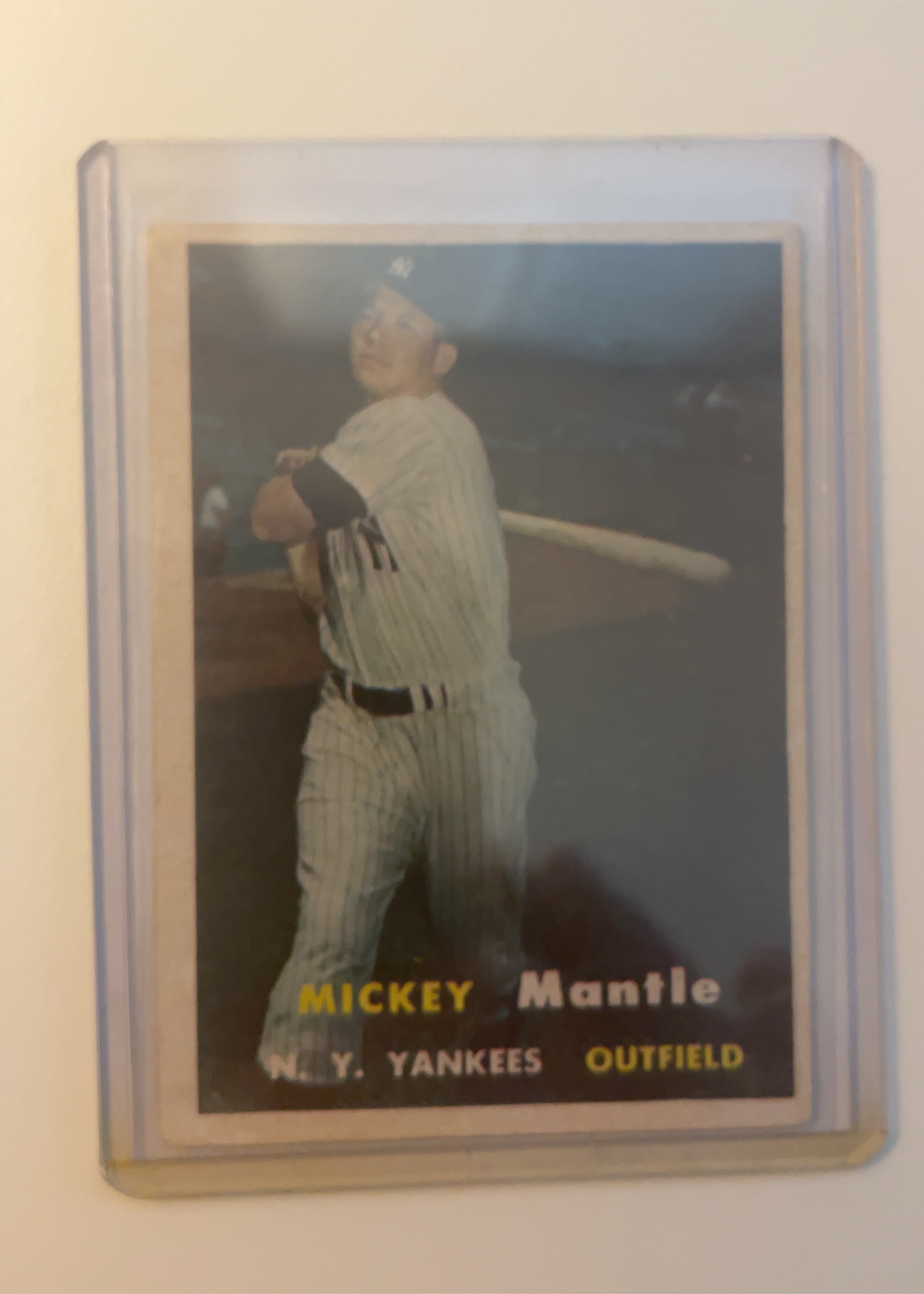
Corners 2.5 · Edges 4.5 · Surface 1.5 · Centering 8
A crease running through the center of this card, combined with overall gloss loss, crushes surface down to 1.5, the lowest of the four axes and the one that sets the overall. Rounded corners add further damage on top of the crease. A crease through the card is close to the single worst thing that can happen to a grade. Centering, at 8, is actually the strongest axis on this card, and it barely matters once a crease is in play.
What this means before you submit
Look back across this ladder and the pattern holds every time: the overall grade is only ever as strong as the weakest of the four axes. That has real money attached to it. The gap between a 9 and a 10 is often the entire profit margin on a grading submission, and as the Charles Barkley and Umbreon ex examples show, that gap can come down to a single half-point of centering that has nothing to do with how well you have cared for the card. One whitened corner, one crease, one stained patch of surface, any of those can cap a card the same way they capped the Aquapolis Lugia or the vintage Mickey Mantle above.
This is exactly why scanning a card before you pay a grading fee matters. A scan shows you all four sub-grades up front, so you know which axis is your weak point before you commit money to a submission. If corners are your problem, you already know a 10 is off the table no matter how clean the surface looks. If it is centering, you know the ceiling before you ever pack the card for shipping. Our breakdown on whether your card is worth grading walks through the actual break-even math once you know your likely grade, and our guide to PSA, BGS, and CGC covers how the same four axes translate differently across grading companies.
Frequently Asked Questions
What is the actual difference between a 9 and a 10?
Usually one axis sitting just below perfect while the other three are maxed out, the way the Charles Barkley example above shows centering at 8.5 while corners, edges, and surface all sit at 9 or higher. A 10 generally requires every axis to be at or near perfect at once, while a 9 allows one axis to fall short.
Can you actually tell a card's grade from a photo?
You can get a strong read on all four sub-grades from a clear, well-lit scan, especially centering, which is a purely geometric measurement rather than a judgment call. Corners, edges, and surface are all visually inspectable from a photo too, which is exactly how the nine cards in this guide were evaluated.
Which sub-grade matters most?
None of them matters more than the others in isolation, because the overall is set by whichever one is weakest on that specific card. The Aquapolis Lugia above had strong corners, edges, and centering, but a surface grade of 5 still capped the whole card at 5.5. The lesson is to check all four, not to assume one axis is safe to ignore.
Do PSA, BGS, and CGC all grade on the same 1 to 10 scale?
They share the same basic 1 to 10 range and the same four underlying axes, but their tolerances and how they combine sub-grades into an overall differ company to company. BGS publishes all four sub-grades on the label, while PSA only shows the overall. See our PSA vs BGS vs CGC comparison for the full breakdown.
Why did my mint-looking card grade lower than I expected?
Almost always because one axis you were not paying close attention to turned out to be the weak point. Centering is the most common surprise, since it is easy to miss with the naked eye but shows up immediately in a measured scan. Surface staining and print spots, like on the Lugia above, are another common culprit on cards that otherwise look pack-fresh.
How many grade levels are covered in this guide?
This guide walks through nine grade levels using real community scans, from a Gem Mint 10 down to a Good 2 (10, 9, 8, 7, 6, 5.5, 4.5, 3, 2), including half-point grades like 5.5 and 4.5 that show up on BGS and CGC labels. For the full official grade-by-grade breakdown of what PSA expects at each level, see our complete grading scale guide.
Written by
Marcus ReevesLead Grading Editor, ZeroPop
Marcus has been collecting and grading trading cards since the late 1990s, with a focus on Pokemon, vintage baseball, and modern basketball. He leads ZeroPop's grading research, runs the editorial team's PSA, BGS, and CGC submission tests, and writes the cost and turnaround tracking that powers the app's ROI calculator.
Free · No account
Know your grade before you submit.
ZeroPop scans your cards and gives instant sub-grades for corners, edges, surface, and centering. PSA, BGS, and CGC estimates included. Free to start.
or get the app
Keep reading
Card Grading Scale: PSA 1 Through 10 Explained
Every grade on the PSA, BGS, and CGC scales broken down with real-world examples, qualifiers, and how sub-grades combine.
Grading GuidesBGS Sub-Grades: How Beckett Calculates the Final Grade
How BGS sub-grades for centering, corners, edges, and surface combine into a final grade. Including the BGS 9.5 Gem Mint and BGS 10 Pristine thresholds.
Grading GuidesIs My Card Worth Grading? The Decision Framework
A practical framework for deciding whether to grade your cards. Covers the break-even math, common traps, and the AI pre-grading approach.
EducationHow to Read a PSA Pop Report (Find Rare Cards)
The 2026 guide to PSA population reports. How to look up pop counts, what the numbers actually mean, how to use them to spot scarce cards, and the multiplier math that drives PSA 10 premiums.
Grading Company ComparisonsPSA vs BGS vs CGC vs SGC: 2026 Grading Comparison
An honest, detailed comparison of every major card grading company (PSA, BGS, CGC, and SGC) covering cost, speed, and market value.