BGS Sub-Grades Explained: How the Pristine 10 Actually Works
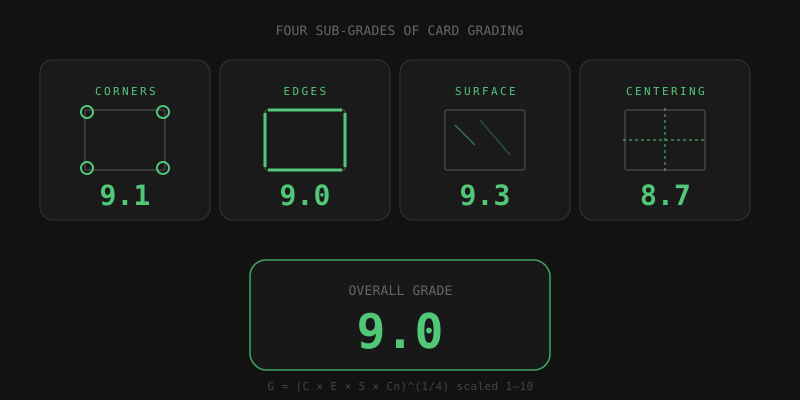
BGS is the only major grading company that publishes all four sub-grades on the slab. PSA grades the same four categories internally but only shows the overall on the label. CGC publishes select sub-grades. BGS publishes everything (corners, edges, surface, and centering), which makes it the most transparent grading system in the hobby.
Understanding how those four numbers combine into a final BGS grade is the key to knowing whether your card is a candidate for the elusive Black Label BGS 10 Pristine, the BGS 9.5 Gem Mint, or a regular BGS 9.
The BGS Grading Scale
BGS 10 Pristine (Black Label). All four sub-grades must be 10. This is the rarest grade in card grading. Perfect across every category with no margin. Black Label BGS 10s are essentially unicorns; population reports show very small numbers even on heavily submitted modern cards.
BGS 10 Pristine (Gold Label). All sub-grades 9.5+, with at least three at 10. Still extremely rare but more achievable than Black Label.
BGS 9.5 Gem Mint. All sub-grades 9+, with at least three at 9.5. The premium grade that most collectors are realistically chasing. Comparable in value to a PSA 10.
BGS 9 Mint. All sub-grades at 8.5+ with at least two at 9+. Common for well-kept modern cards. Below the typical grading premium threshold for most cards.
BGS 8.5 NM-MT+ and below. Cards with one or more sub-grades below 8.5. Generally not worth submitting unless the card itself is high-value.
The Four BGS Sub-Grade Categories
Centering. Measured numerically as a left/right and top/bottom ratio. BGS centering is stricter than PSA. A card that gets PSA 10 centering at 55/45 might only get BGS 9.5 centering, and to clear BGS Black Label 10 centering, the card needs to be 50/50 or extremely close.
Corners. Inspected under loupes for sharpness, whitening, and rounding. BGS is slightly less forgiving than PSA on micro-whitening at the corner tips.
Edges. All four edges examined for whitening, chipping, and roughness. BGS sometimes catches edge issues PSA misses, especially on freshly pulled cards.
Surface. Front face inspected for scratches, scuffs, print defects, and gloss issues. BGS uses angled light to catch holo surface flaws.
How BGS Combines Sub-Grades Into a Final Grade
BGS uses a published formula. The final grade is determined by:
- The lowest sub-grade sets the floor.
- The second-lowest sub-grade caps how high the overall can go.
- There is a small bump if the gap between the lowest and second-lowest is large enough.
Practically:
- Sub-grades 10/10/10/10 → BGS 10 Pristine (Black Label).
- Sub-grades 10/10/10/9.5 → BGS 9.5 Gem Mint.
- Sub-grades 10/10/9.5/9.5 → BGS 9.5 Gem Mint.
- Sub-grades 9.5/9.5/9/9 → BGS 9 Mint.
- Sub-grades 9.5/9.5/9.5/8.5 → BGS 9 (the 8.5 in centering pulls it down despite three strong sub-grades).
This is exactly why centering kills so many BGS submissions. A card with three perfect 9.5 sub-grades but 8.5 centering does not get BGS 9.5. It gets BGS 9.
The BGS Centering Score Specifically
BGS centering is measured on the front and the back. The lower of the two is what counts.
BGS 10 centering: 50/50 or essentially perfect on both axes. Tolerance is roughly ±1%.
BGS 9.5 centering: Up to 55/45.
BGS 9 centering: Up to 60/40.
BGS 8.5 centering: Up to 65/35.
This matters for crossover decisions. A PSA 10 with 55/45 centering can become a BGS 9.5 (centering subgrade pulled down to 9.5 from 10), but never a BGS Black Label 10. Cards crossing from PSA to BGS targeting Black Label need to be 50/50 centered.
Free · No account
Grade your first card free.
No account, no download, no waiting. Photograph the front and the back and get the overall grade back in about a minute.
or get the app


Why Black Label BGS 10 Is So Rare
Two reasons:
Centering is unforgiving. 50/50 manufacturing is rare. Most cards leaving the print run have at least 1 to 2% drift on one axis, which puts them at 9.5 centering and out of Black Label contention.
Every sub-grade must be 10. Three perfect sub-grades and one 9.5 disqualifies the card from Black Label. This is mathematically harder than a PSA 10 (which has effective sub-grade tolerance because BGS publishes the sub-grades and PSA doesn't).
Black Label population reports show some cards with under 10 copies in existence. Pristine BGS 10 carries a multiple-of-PSA-10 premium for high-end modern cards because of this scarcity.
Strategy: When BGS Beats PSA
BGS is the better target when:
The card has perfect 50/50 centering. PSA 10 caps your upside; BGS Black Label uncaps it.
You want to display the card with grade transparency. BGS sub-grades on the slab let buyers see exactly why the card scored what it scored.
You're crossing over a PSA 10 with strong sub-grades. A PSA 10 with all-10 internal sub-grades is a candidate for BGS 9.5 or 10. Cards with weaker internal sub-grades (centering closer to 60/40) cannot meaningfully cross over and should stay PSA.
You collect vintage with thick borders. Vintage centering measurement is more forgiving on BGS than PSA in some eras.
PSA is the better target when:
You want maximum liquidity. PSA has the deepest secondary market. A PSA 10 sells faster than a BGS 9.5 of the same card on most platforms.
The card has slightly off centering. PSA's wider tolerance gives you a real shot at PSA 10; BGS does not.
You're submitting modern Pokémon at scale. PSA's pricing and turnaround for bulk submissions is friendlier.
How AI Grading Apps Predict BGS Grades
A modern AI card grading app trained on BGS results predicts each of the four sub-grades, applies the BGS combining formula, and returns a predicted final grade. The same scan that predicts PSA 10 may predict BGS 9.5 because of the centering tightness.
For Black Label hunting specifically, look for an app that flags whether the card hits the 50/50 centering threshold. ZeroPop's centering analyzer reports the exact L/R and T/B ratios so you can see whether you're in Black Label range or just BGS 9.5 range. Before you spend the BGS submission fee.
Common BGS Sub-Grade Combinations and What They Mean
10 / 10 / 10 / 10: Black Label Pristine. Submit with confidence.
10 / 10 / 10 / 9.5: Gold Label 10 if BGS rounds favorably; usually BGS 9.5 Gem Mint. Still elite.
10 / 10 / 9.5 / 9.5: Solid BGS 9.5 Gem Mint. Strong card.
10 / 9.5 / 9.5 / 9.5: BGS 9.5 with margin to spare.
9.5 / 9.5 / 9.5 / 9: BGS 9 Mint. The 9 in one sub-grade pulls the floor down.
9.5 / 9.5 / 9 / 9: BGS 9. Minimum for the Mint label.
9 / 9 / 9 / 9: BGS 9 baseline. No premium over PSA 9 for most cards.
If your AI scan returns three 9.5s and an 8.5, you should know going in that BGS 9.5 is off the table. The 8.5 will cap you at BGS 9.
Frequently Asked Questions
What is the difference between BGS 9.5 and BGS 10?
BGS 9.5 (Gem Mint) requires all four sub-grades at 9+ with at least three at 9.5+. BGS 10 (Pristine, Gold Label) requires all sub-grades at 9.5+ with at least three at 10. BGS 10 Black Label requires all four sub-grades to be perfect 10s. The rarest grade in the hobby.
Why is BGS centering stricter than PSA?
BGS uses tighter tolerances at the top end. PSA 10 centering allows up to 55/45; BGS 10 centering requires essentially 50/50. This is why a PSA 10 may only translate to BGS 9.5 on crossover, even with the same physical card.
Are BGS sub-grades shown on the slab?
Yes. BGS publishes all four sub-grades (centering, corners, edges, surface) directly on the label. PSA does not show sub-grades on the slab. CGC shows select sub-grades depending on the tier.
Is BGS 9.5 worth more than PSA 10?
Usually similar. BGS 9.5 and PSA 10 trade at comparable prices for most modern cards on the secondary market. BGS Black Label 10 carries a significant premium because of its scarcity.
Can I use an AI app to predict BGS sub-grades?
Yes. Apps like ZeroPop predict BGS sub-grades using the same image-analysis pipeline they use for PSA, then apply BGS's combining formula. Centering measurements are particularly accurate because they are objective ratios.
Should I submit my card to BGS or PSA?
If your card has 50/50 centering and all sub-grades clear 9.5, BGS Black Label is a real possibility and worth the submission. Otherwise, PSA usually offers better resale liquidity. Run an AI scan first to see what each company's predicted grade looks like before deciding.
Written by
Marcus ReevesLead Grading Editor, ZeroPop
Marcus has been collecting and grading trading cards since the late 1990s, with a focus on Pokemon, vintage baseball, and modern basketball. He leads ZeroPop's grading research, runs the editorial team's PSA, BGS, and CGC submission tests, and writes the cost and turnaround tracking that powers the app's ROI calculator.
Free · No account
Know your grade before you submit.
ZeroPop scans your cards and gives instant sub-grades for corners, edges, surface, and centering. PSA, BGS, and CGC estimates included. Free to start.
or get the app
Keep reading
PSA Grading Standards: How PSA Actually Grades Cards
The exact PSA grading standards used in 2026. Corners, edges, surface, centering tolerances at every grade from PSA 1 to PSA 10. Real examples and tolerances.
Grading Company ComparisonsPSA vs BGS vs CGC vs SGC: 2026 Grading Comparison
An honest, detailed comparison of every major card grading company (PSA, BGS, CGC, and SGC) covering cost, speed, and market value.
Grading GuidesCard Crossover Guide: When to Cross PSA, BGS, CGC
When crossover submissions make sense. PSA to BGS, CGC to PSA, BGS to PSA. And how to predict the new grade before you pay the crossover fee.