The Most Valuable Charizard Cards to Grade in 2026, Every Chase Ranked
No Pokemon has ever meant more money on a piece of cardboard than Charizard. A PSA 10 1st Edition Base Set Charizard sold for $954,800 in February 2026, the record for the English card, and a Japanese "No Rarity" 1996 copy has traded near $1.7 million. But the grading market is not just a handful of six-figure grails. It runs from that 1999 Base Set holo down to a $117 modern Special Illustration Rare, and every tier has a different answer to whether it is worth submitting. Ten cards make this list, ranked by value, from that $117 entry point to the million dollar ceiling.
Why Charizard Still Sets the Market
Every other chase character in the hobby gets compared to Charizard, not the other way around. Thirty years of demand means every Charizard printing, from a 1999 Unlimited holo to a 2026 Special Illustration Rare, has an active population of graded copies and a real secondary market, something most modern chase cards lack until months after release.
That depth of data is also why grading Charizard rewards care over hope. The four sub grades, corners, edges, surface, and centering, decide a PSA 10 the same way they do on any card, but the gap between a 9 and a 10 is worth far more here. See how to grade Pokemon cards for the mechanics of each axis, and PSA vs BGS vs CGC for which grading company fits which era.
Three risk patterns repeat across the list below. Base Set era cards from 1999, Unlimited, Shadowless, and 1st Edition, share the same soft print stock that whitens at the corners with age. Foil and textured surfaces, from Crystal Charizard's crystal pattern through modern Special Illustration Rares, catch print lines and scratches that a flat card hides. Modern full art cards add a third risk: frames cut tight to the border, where an uneven centering split is enough to cap a 10 at a 9.
How We Ranked These
This list orders ten Charizard cards by real grading upside, current PSA 10 value weighed against how attainable that grade is. Vintage prices reflect actual recent sales. Modern cards use current market prices, which move fast and should be checked against a live source before you submit. Where a hard PSA 10 comp does not exist yet, we say so instead of guessing.
The Charizard Countdown: 10 Cards Worth Grading in 2026
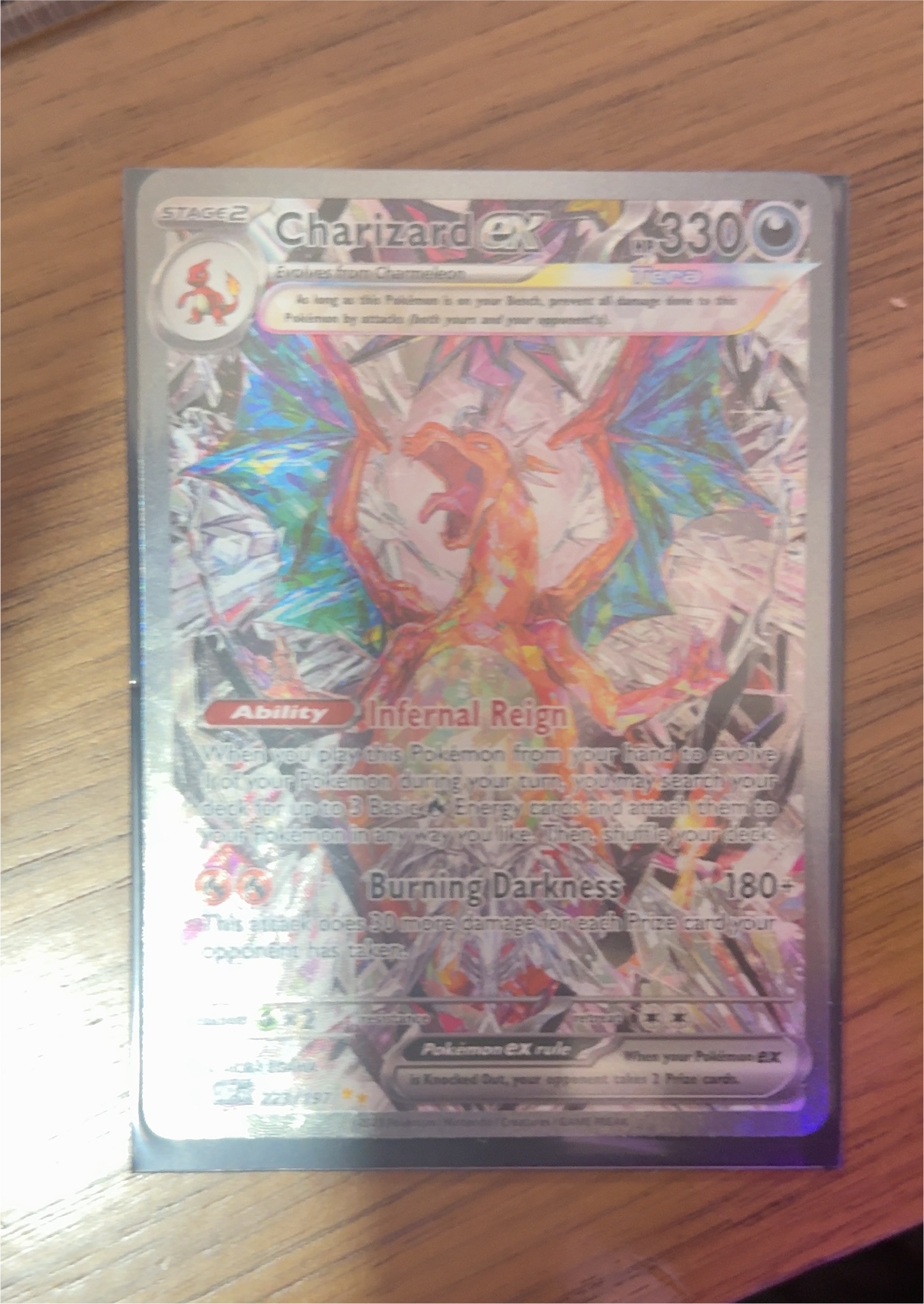
10. Charizard ex, Special Illustration Rare (Obsidian Flames, 223/197, 2023)
Obsidian Flames turned Charizard ex into a Darkness type through the set's Terastal mechanic, and Akira Egawa's full art treatment made it the chase of the release. The dark, textured background hides less than it looks: surface scratches and edge whitening from a rough pack pull show clearly under a light. Raw copies trade near $117; PSA 10s reach $250 to $300 on current guides, the entry point tier and the card most collectors here actually own.
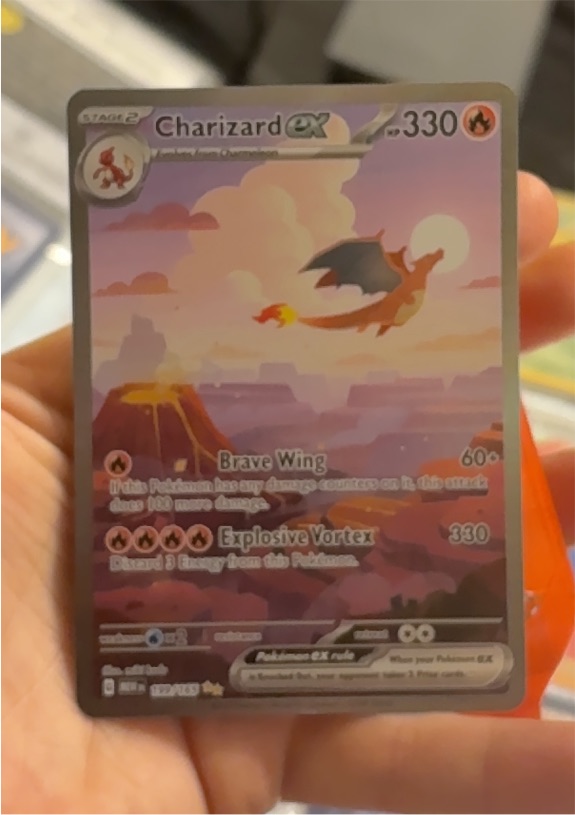
9. Charizard ex, Special Illustration Rare (Scarlet & Violet 151, 199/165, 2023)
The 151 set reprinted the original 151 Pokemon in modern frames, and its Charizard ex SIR became the single most in demand card of the Scarlet and Violet era. Centering is the swing axis: this print runs tight to the border on many sheets, and a 60/40 cut on either side caps the grade at a 9 even on an otherwise flawless copy. Raw runs near $400, among the highest raw prices of any modern Charizard; PSA 10 copies trade between $700 and $900, a real but modest multiple given the demand.
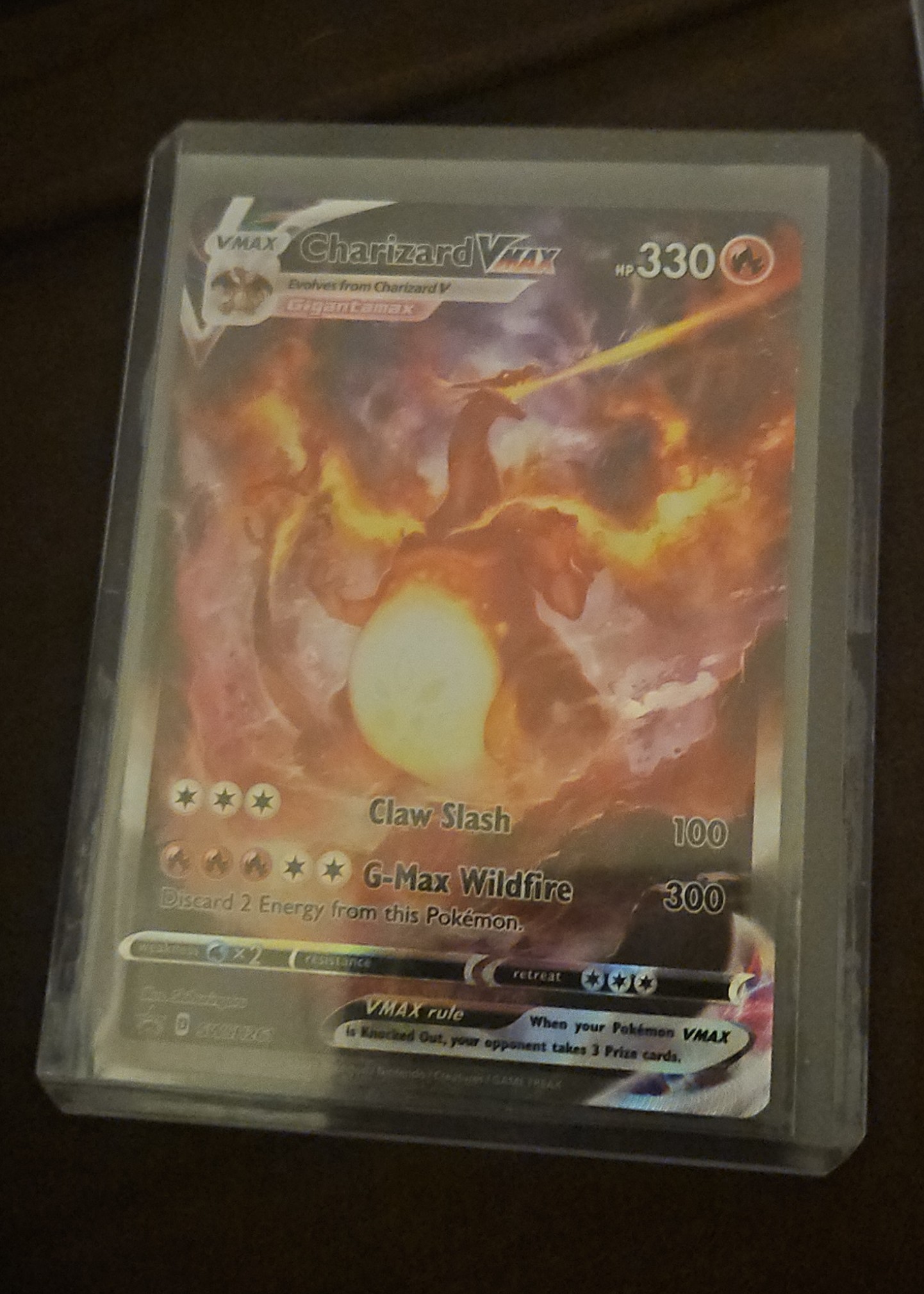
8. Charizard VMAX, Rainbow Secret Rare (Champion's Path, 74/73, 2020)
Champion's Path was a small set built almost entirely around one card, and the full art Rainbow Secret Rare Charizard VMAX became the defining chase of the pandemic era Pokemon boom. This run shows more surface variance than most modern sets, print lines and light scuffing that a standard holo would hide. Raw copies recently sold near $220; PSA 10 pricing starts around $400 and climbs from there, well above raw but a fraction of the card's peak 2021 demand.
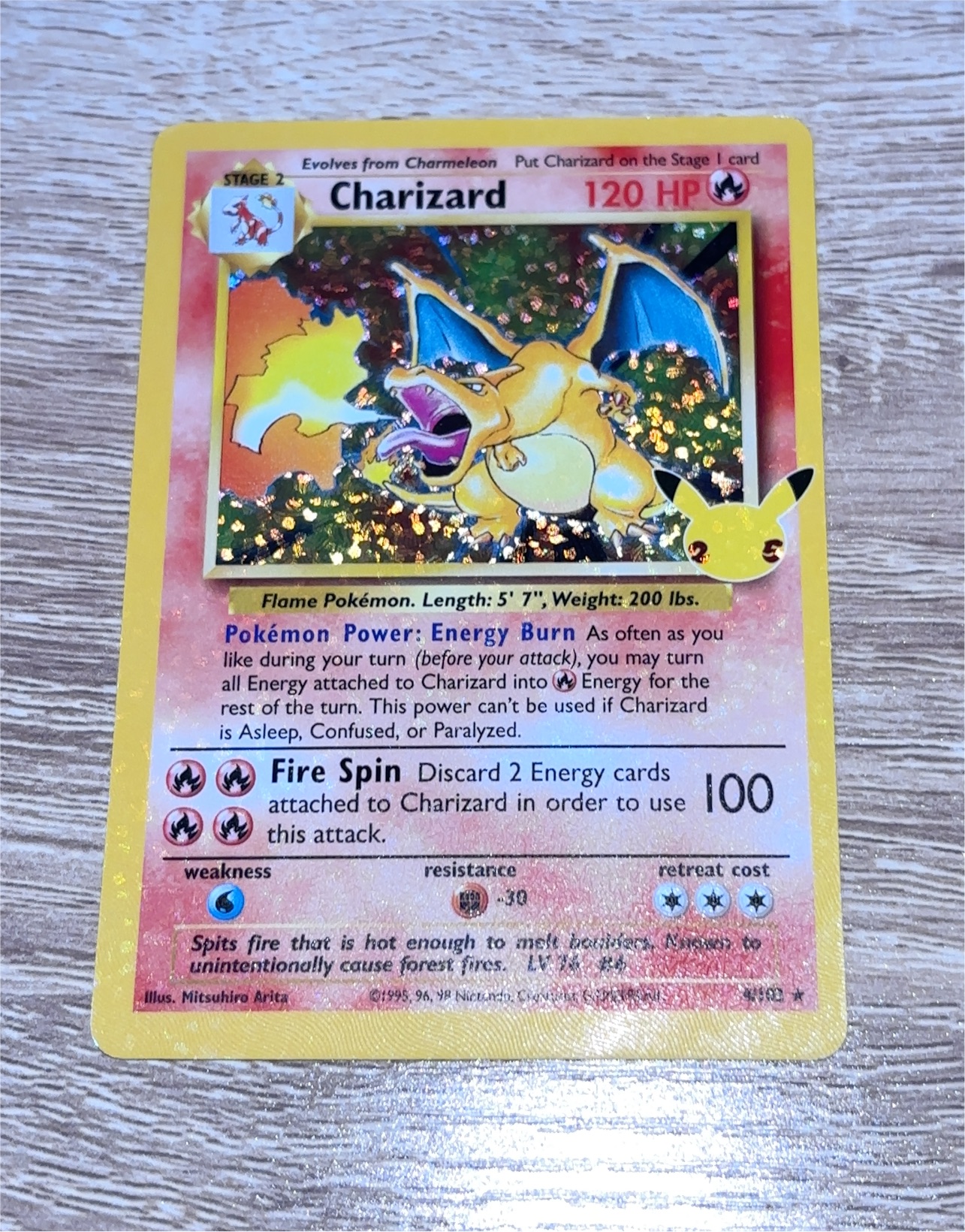
7. Charizard, Unlimited Holo (Base Set, 4/102, 1999)
This is the most accessible way into the original Base Set Charizard chase. Most collectors who grew up with the card in the late 1990s owned this exact print, not the scarcer 1st Edition or Shadowless variants. Twenty six years of handling means most surviving copies already show print lines or edge wear, and corners are the biggest risk of the three Base Set prints. Raw copies in played condition run low, but a genuine Near Mint candidate is worth screening: PSA 10 copies have sold between roughly $4,000 and $7,000, a real jump for a card this old.
Free · No account
Grade your first card free.
No account, no download, no waiting. Photograph the front and the back and get the overall grade back in about a minute.
or get the app


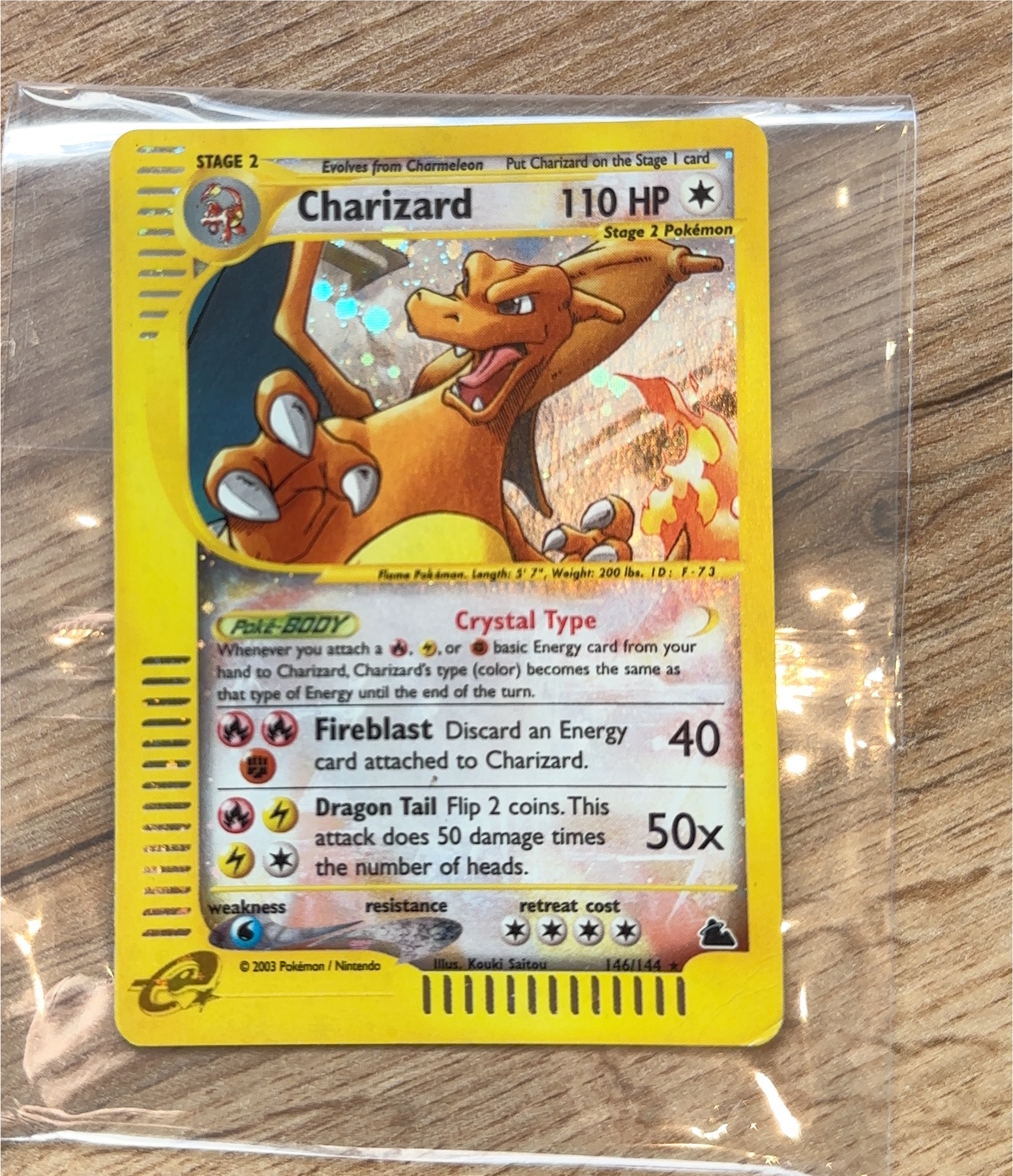
6. Crystal Charizard, Secret Rare (Skyridge, 146/144, 2003)
Skyridge's holofoil texture was unlike anything printed before it, and Crystal Charizard, its secret rare, became one of the defining chase cards of the e-Card era. Surviving high grade copies are genuinely scarce, and PSA 10 population reports stay thin even decades after release. Recent PSA 10 sales have landed between $9,600 (March 2023) and $14,030 (September 2024), with current asking listings stretching into the tens of thousands, a sign of how few copies change hands at the top of this card's population.
5. Charizard, Shadowless Holo (Base Set, 4/102, 1999)
Printed in the earliest Base Set run, before the shadow graphic was added around the artwork box, Shadowless Charizard sits between Unlimited and 1st Edition in scarcity and value. These early copies also show centering issues more often than the later Unlimited run, since the printing process was still being refined. Raw Shadowless copies in strong condition start around $1,000; PSA 10 graded copies have sold above $30,000, a much steeper jump than Unlimited and a sign of how few Gem Mint Shadowless copies exist.
4. Charizard, Gold Star (EX Dragon Frontiers, 2006)
Gold Star cards were a short lived, low print rarity from the mid 2000s, and Charizard's entry is the most chased card in the subset, trading like a top tier modern chase because so few were printed. The gold foil pattern shows handling marks starkly, and since the print run was small to begin with, a damaged copy is genuinely harder to replace than a mainline card from the same era. PSA 10 copies have traded in the $55,000 to $60,000 range, among the highest values of any single Charizard printed after the original Base Set era.
3. Shining Charizard, 1st Edition (Neo Destiny, 107/105, 2002)
Shining Charizard was one of the first "Shining" rarity cards, a reverse holo treatment applied to a small set of Pokemon, and the 1st Edition print is dramatically scarcer than the standard Unlimited version most collectors encounter (a non 1st Edition copy in PSA 10 trades closer to $8,000, a completely different card financially). The reverse holo pattern also reveals print lines more readily than a standard holo, and 1st Edition stock from this era shows corner softness at a higher rate than later Neo era printings. There is no recent PSA 10 sale to point to as this guide goes to print, but a PSA 9 copy already sold for $69,541 in June 2026. A true Gem Mint 1st Edition would set a new high the moment one changes hands.
2. Charizard, 1st Edition Holo (Base Set, 4/102, 1999)
The single card most responsible for Pokemon's collectible card market existing as a serious asset class. Every major Charizard sale headline traces back to this exact print, the black "1st Edition" stamp on a 1999 Base Set holo. The market pays an exponential premium for a true Gem Mint copy, so even a hint of a soft corner is the difference between a five figure and a six figure outcome. Recent 2026 sales have ranged from about $420,000 to $580,000, with a record $954,800 sale in February 2026 and a $579,000 sale as recently as June 4, 2026, the practical ceiling for a card most collectors could realistically own and submit.
1. Charizard, No Rarity (Japanese Base Set, 1996)
The very first Charizard ever printed, from Japan's original 1996 base set, before the game had a rarity symbol system at all. It predates the English 1st Edition by three years and survives in far smaller Gem Mint numbers, since nobody treated a 1996 pack pull as a future grail at the time. Population data here is thinner than on the English prints, so a single fresh PSA 10 sale can move the market's understanding of what the card is worth overnight. The top graded copy has sold for approximately $1.7 million, the current world record for any Charizard card and among the highest prices ever paid for a Pokemon card in any language. It is a museum piece more than a realistic submission target for almost anyone reading this, but it sets the ceiling every other card here is measured against.
The ZeroPop Verdict: Which Charizard to Grade First
Realistically, almost nobody reading this owns a Japanese No Rarity Charizard or a true Gem Mint 1st Edition. The actionable tier starts at Shadowless and Unlimited Base Set Charizard: if you have a genuine 1999 copy in strong condition, screen it before deciding it is only worth a display case. Crystal Charizard and Gold Star Charizard reward the same patience for anyone who already owns one, since both carry real five figure PSA 10 upside against a thin comp set.
For most collectors, the practical decision lives in the modern tier. A Champion's Path VMAX, a 151 Charizard ex, or an Obsidian Flames SIR all clear the math at $100 to $400 raw when a scan shows genuinely clean corners, edges, and centering, and centering is the single biggest reason a modern Charizard misses a 10. Scan every pull, check all four sub grades, and let the numbers, not the name on the card, decide whether it ships to a grader. See is my card worth grading for the break even math and best cards to grade in 2026 for this year's strongest submissions.
Frequently Asked Questions
What is the most valuable Charizard card?
The 1996 Japanese "No Rarity" Base Set Charizard holds the record, near $1.7 million for a top graded copy. Among English cards, the 1999 Base Set 1st Edition Holo Charizard is the ceiling, with a PSA 10 selling for $954,800 in February 2026.
Is a 1st Edition Base Set Charizard worth more than an Unlimited copy?
Significantly more. A PSA 10 1st Edition copy has sold for over $900,000, while a PSA 10 Unlimited copy trades between roughly $4,000 and $7,000. Shadowless sits in between, with PSA 10 sales above $30,000. Check for the black "1st Edition" stamp and the shadow graphic around the artwork box before assuming which print you own.
Which modern Charizard card should I actually grade?
The 151 Charizard ex Special Illustration Rare and the Champion's Path Charizard VMAX Rainbow Secret Rare both clear the grading math at their current raw prices when a scan shows clean centering and corners, the biggest risk on both since full art frames run tight to the border.
Should I submit a vintage Charizard to PSA, BGS, or CGC?
PSA carries the deepest population history and the strongest resale premium for vintage Charizard, which is why almost every record sale on this list is a PSA graded copy. See PSA vs BGS vs CGC for how the three companies compare on cost and resale value.
What is the biggest grading risk on a Charizard card?
It depends on the era. Vintage Base Set Charizard from 1999 whitens at the corners easily because of the soft print stock of the time. Foil era Charizard, from Crystal Charizard through modern Special Illustration Rares, shows surface scratches far more readily than a standard card. Modern full art Charizard cards add centering as a third major risk, since the border runs tight to the frame edge.
Is a non 1st Edition Shining Charizard the same as the 1st Edition version?
No, and mixing them up is a costly mistake. The 1st Edition Neo Destiny Shining Charizard already had a PSA 9 sell for $69,541 in June 2026, while a standard Unlimited copy in PSA 10 trades closer to $8,000, a completely different price tier for a card that looks nearly identical at a glance.
Written by
Marcus ReevesLead Grading Editor, ZeroPop
Marcus has been collecting and grading trading cards since the late 1990s, with a focus on Pokemon, vintage baseball, and modern basketball. He leads ZeroPop's grading research, runs the editorial team's PSA, BGS, and CGC submission tests, and writes the cost and turnaround tracking that powers the app's ROI calculator.
Free · No account
Know your grade before you submit.
ZeroPop scans your cards and gives instant sub-grades for corners, edges, surface, and centering. PSA, BGS, and CGC estimates included. Free to start.
or get the app
Keep reading
Pokemon Cards Worth Grading in 2026: Top Targets
Which Pokemon cards are actually worth grading in 2026. Vintage, modern, Japanese, and Prismatic Evolutions chase cards ranked by PSA 10 ROI.
Grading GuidesBest Cards to Grade in 2026: Top ROI Picks
The 12 cards most worth grading in 2026 across Pokémon, baseball, football, basketball, and MTG. Ranked by PSA 10 premium and grading-cost ROI.
Grading Company ComparisonsPSA vs BGS vs CGC vs SGC: 2026 Grading Comparison
An honest, detailed comparison of every major card grading company (PSA, BGS, CGC, and SGC) covering cost, speed, and market value.
PokemonHow to Grade Pokemon Cards: The Complete 2026 Guide
Pokemon-specific grading guide covering holo types, centering issues, common defects, which cards to grade, and how to inspect at home.
Grading GuidesPokemon Card Silvering: How Much Hurts a PSA Grade
What silvering on Pokemon cards actually is, how to spot it, and how much silvering drops a card from PSA 10 to PSA 9 to PSA 8.
Grading GuidesIs My Card Worth Grading? The Decision Framework
A practical framework for deciding whether to grade your cards. Covers the break-even math, common traps, and the AI pre-grading approach.