2026 Topps Finest Baseball: Super Rare Tier and Grading Guide
2026 Topps Finest Baseball released Wednesday, July 8, the biggest structural change to the product in years. For the third straight season the base checklist runs on a tiered system (Common, Uncommon, Rare), but 2026 adds a hobby-exclusive Super Rare tier of 50 cards that pushes the base set to 350 and compresses top-end scarcity into a shorter rainbow. Topps also shipped the first-ever Finest Mega boxes this year, carrying exclusive Mini Diamond Refractors. This guide covers the box math, the refractor ladder, the rookie autograph class, and why chromium stock caps a PSA 10 differently than the paper flagship it draws from.
What Is in 2026 Topps Finest Baseball
Finest is Topps' refractor-finish sibling to the paper flagship (our 2026 Topps Series 2 guide covers that release), the same chromium format that made Topps Chrome the standard-bearer for shiny cardboard (see our 2026 Topps Chrome guide for that companion product). Finest builds its own 350-card base set around the tiered structure Topps introduced a few years back: Common, Uncommon, and Rare tiers running the full refractor rainbow, now joined by a new fourth tier.
That new wrinkle is Super Rare, a 50-card hobby exclusive with a deliberately truncated rainbow: only Black Refractor (/10), Red Refractor (/5), and the 1/1 SuperFractor exist for a Super Rare subject. No unnumbered Refractor, no Gold, no Green. Every Super Rare pull is already scarce before the autograph odds even enter the picture, and it is the single biggest checklist change Topps has made to Finest in years.
Every hobby box guarantees two on-card autographs, and the insert lineup leans on returning names: Arrivals for the top prospect class, Finest Timelines, and Topps Team Finest for veteran chase. The headline return is World's Finest, back for the first time since 2023, spotlighting World Baseball Classic talent alongside new low-odds chase lines like Aura and Nightmare Fuel.
Box Configurations and Where to Buy In
Finest ships in four formats this year, and the one you buy changes both autograph math and parallel odds.
| Configuration | Cards/Pack | Packs/Box | Boxes/Case | Autographs | Notes |
|---|---|---|---|---|---|
| Hobby | 10 | 6 | 8 | 2 guaranteed | Deepest rainbow, hobby-exclusive X-Fractor and Oil Spill parallels |
| First Day Issue (FDI) | 10 | 6 | N/A | 2 guaranteed | Early-window release, its own exclusive parallel plus a standard hit |
| Mega | 6 | 8 | 20 | Not guaranteed | First-ever Finest Mega box; exclusive Mini Diamond Refractors |
| Breaker Delight | 10 | 1 | 6 | Concentrated odds | Single-pack box, boosted per-pack hit rate |
Hobby boxes are listing in the $340 to $350 range at initial retail, with FDI boxes running well above that through a Dutch auction on release week. Mega boxes are trading closer to $70, within reach of collectors who want the Mini Diamond chase without a hobby box's price tag.
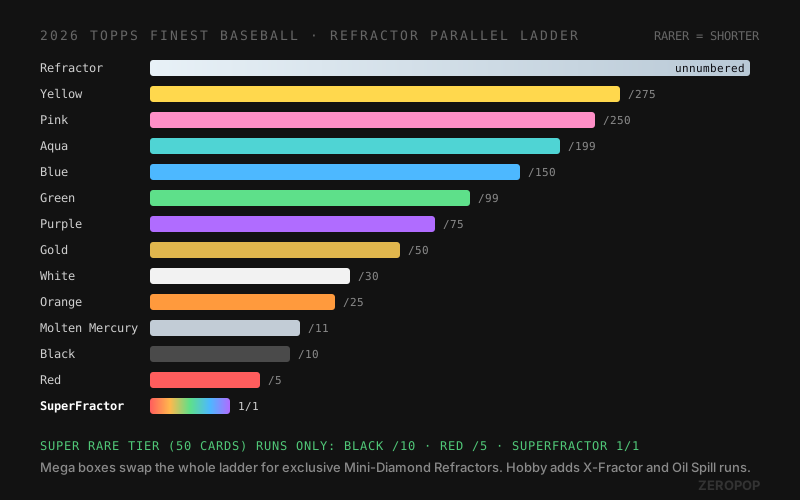
The Refractor Parallel Ladder
Finest's identity is the rainbow, and 2026 runs a long one on the Common, Uncommon, and Rare tiers.
| Parallel | Print run | Where it falls |
|---|---|---|
| Refractor | Unnumbered | Base rainbow entry point |
| Yellow Refractor | /275 | Early numbered tier |
| Pink Refractor | /250 | Early numbered tier |
| Aqua Refractor | /199 | Early numbered tier |
| Blue Refractor | /150 | Mid numbered tier |
| Green Refractor | /99 | Mid numbered tier |
| Purple Refractor | /75 | Upper numbered tier |
| Gold Refractor | /50 | Upper numbered tier |
| White Refractor | /30 | Scarce tier |
| Orange Refractor | /25 | Scarce tier |
| Molten Mercury Refractor | /11 | Scarce tier |
| Black Refractor | /10 | Very scarce |
| Red Refractor | /5 | Very scarce |
| SuperFractor | 1/1 | Single copy |
Hobby boxes add their own exclusive X-Fractor run (Green through SuperFractor) plus an Oil Spill Refractor shared only between Hobby and FDI. Mega boxes replace the whole ladder with Mini Diamond Refractors, a matching color run that never appears in a hobby pack. Remember the Super Rare tier only carries Black, Red, and SuperFractor, so a Super Rare Black Refractor and a Common-tier Black Refractor are not the same scarcity even though both read "/10." Check the tier printed on the card before comparing two numbered parallels.
The Rookie and Veteran Chase
Finest pulls from the same 2026 rookie class anchoring Chrome and Series 2, and the top five names all have autograph slots across the Finest Prospects and Finest Futures tiers.
Trey Yesavage. The right-hander who helped Toronto reach the 2025 World Series (3-1, 3.58 ERA, 39 strikeouts in six postseason outings) opened 2026 on the injured list with a shoulder issue, but the postseason résumé keeps demand steady. Real early listings put a Finest Purple Refractor autograph (/75) around $249 raw. The biggest grade risk is edge chipping, chromium cuts nick more visibly on a card this reflective, so check all four edges, not just the corners.
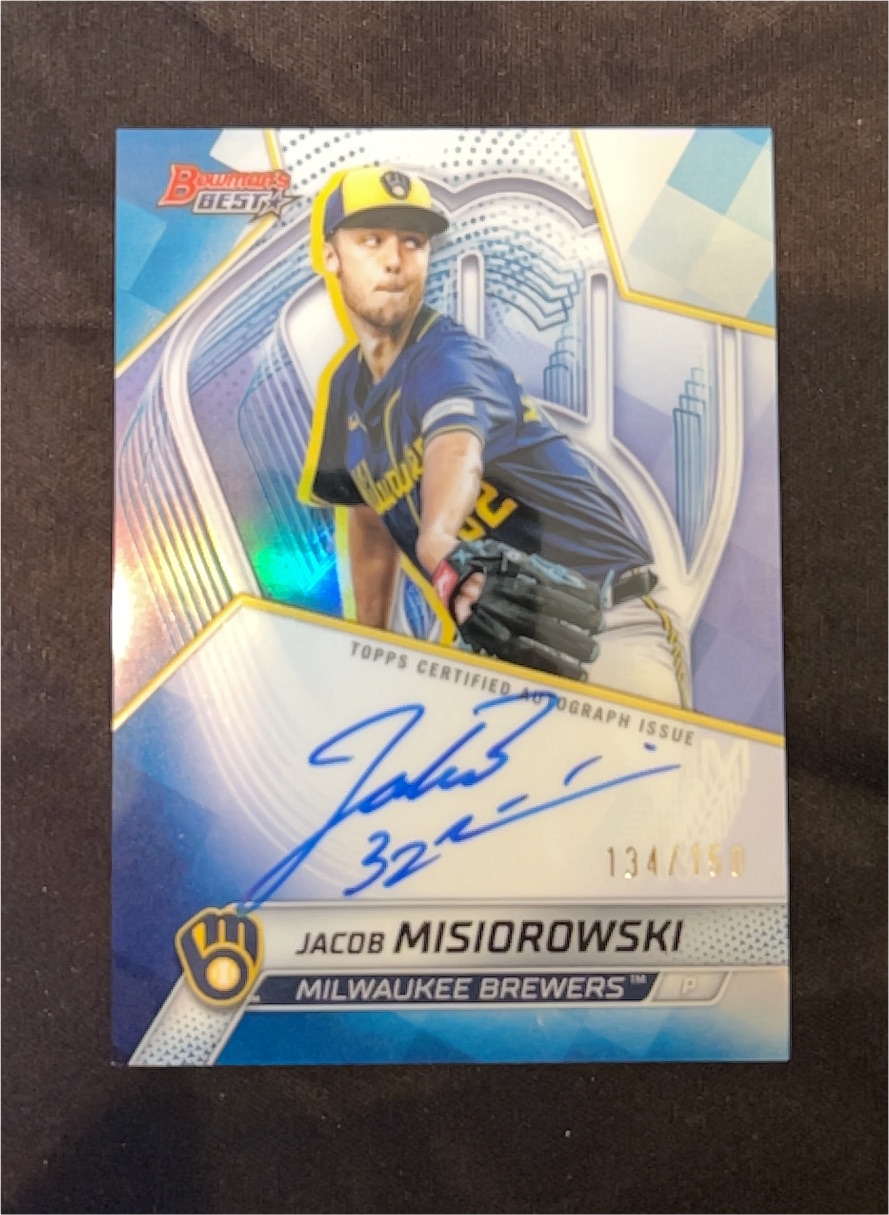
Jacob Misiorowski. The Brewers right-hander is having the best rookie season of the class, 8-3 with a 1.45 ERA and an MLB-leading strikeout rate, and his cards across every 2026 product are trading well above preseason valuations. A comparable Topps Chrome Gold Refractor autograph (/50) sold for $637.50 raw this month, a reasonable proxy for a similarly numbered Finest parallel. Surface is the risk here: an on-fire rookie's cards get handled and photographed more, and chromium shows fingerprint oil under raking light the way paper never would.
Konnor Griffin. Widely regarded as the game's top overall prospect, Griffin was hitting .321 over his last 14 games before a forearm strain sidelined him in late May. His earliest Bowman Chrome prospect autographs have sold for five-figure sums at the rarest print runs, a signal of the ceiling on this name rather than a Finest-specific comp. Centering is the axis to watch, his cards see heavy secondary-market handling almost immediately, and a soft corner from top-loader swaps is common by submission time.
Kevin McGonigle and JJ Wetherholt. Both infielders currently lead Rookie of the Year polling, McGonigle on a .305 average with 19 home runs in the minors last year, Wetherholt on a .306 line with 17 homers and 23 steals. Cross-product McGonigle autographs have sold as high as $6,000 for a PSA 10 gold-tier refractor and $4,800 for a red refractor (/5), though those are Bowman Chrome comps carrying a "first Bowman" premium a Finest MLB rookie auto will not fully match. Expect Finest pricing on both names to track below those peaks, with numbered parallels from Blue Refractor and scarcer holding the real premium.
One honest caveat: the set is two days old. PSA has essentially zero population data on any 2026 Finest card right now, so any "PSA 10 price" quoted online this early is market extrapolation, not a real comp. That is exactly the gap a pre-submission scan closes, you can know your card's real corner, edge, surface, and centering reads before committing a grading fee to a population that does not exist yet.
Free · No account
Grade your first card free.
No account, no download, no waiting. Photograph the front and the back and get the overall grade back in about a minute.
or get the app


Grading Finest: Why Refractors Cap a PSA 10 Differently
This is the section a price list will never give you. Chromium stock behaves nothing like paper under a grader's loupe, and the axis that caps your PSA 10 shifts accordingly.
Surface, not centering, is the number one risk. On a paper card like the Series 2 flagship, centering does most of the work capping a grade. On Finest, the mirrored refractor coating shows scuffs, fingerprint oils, and micro scratches that a matte card would hide completely. A card that looks pack-fresh in normal light can reveal a web of hairline surface marks under raking light, and those marks read the same on a Common-tier base card as on a numbered Super Rare pull. Check every angle before deciding a card is submission-ready.
Edges chip more visibly on chromium than on paper. The coating is thinner and more brittle at the cut edge than a paper card's fibrous edge, so factory nicks and pack-wear chipping show up as bright white breaks against the refractor finish. This is a measurable defect, not a lighting trick, and it deserves a look at all four edges, not a corner-only glance.
Centering still matters, especially on the colored tiers. Blue, Green, Purple, Gold, and the scarcer refractors show their diffraction pattern differently depending on where the image sits relative to the border, which makes an off-center refractor easier to spot by eye than an off-center paper card. PSA still measures to the printed border the same way regardless, so a refractor that looks centered under studio lighting can still miss by grader standards.
Print lines are the false-positive risk. A faint horizontal line across a refractor's surface can be a genuine print defect, or chromium reflection catching a light source at a specific angle. Rotate the card through at least three angles before calling a line real, this is where a consistent scan pipeline earns its keep over a glance under a desk lamp. For the full four-axis framework, see is my card worth grading, and for how PSA, BGS, and CGC weigh chromium stock, see PSA vs BGS vs CGC.
What to Grade and What to Flip
Grade the numbered rookie autographs from the top five names, Blue Refractor or scarcer, if the surface passes. A McGonigle, Griffin, Wetherholt, Yesavage, or Misiorowski autograph on a numbered parallel carries both the autograph print run and the parallel print run working in its favor, supporting a real premium over raw once confirmed PSA 10. Scan the surface first, then run the numbers.
Treat unnumbered Refractor autographs as flip-or-hold, not an automatic grade. The base Refractor tier behaves like a common card in supply terms once a few weeks of pulls hit the market, and its PSA 10 population builds fast, compressing any premium. Run the break-even math (see best cards to grade in 2026) before committing a submission fee to an unnumbered card.
Super Rare tier singles are a different kind of decision. Because the Super Rare rainbow only runs Black, Red, and SuperFractor, every pull in that tier starts scarce even on a common player, before any autograph is involved. Document condition thoroughly before deciding to grade or sell raw.
World's Finest and Topps Team Finest are the lower-cost value play. Back for the first time since 2023 and built around World Baseball Classic talent, these inserts carry built-in demand well below the top rookie autographs, a real chase without Super Rare-level cost.
Mega Box vs Hobby Box: Which Format Fits Your Strategy
The first-ever Finest Mega box changes the calculus for anyone not chasing an autograph guarantee. Hobby remains the right buy if two on-card autographs per box is the priority, and it is the only format carrying the hobby-exclusive X-Fractor and Oil Spill parallels. Mega trades the autograph guarantee for a lower price point and the Mini Diamond Refractor ladder, a parallel run that exists nowhere else, plus exclusive inserts like Finest Forces and Finest Futures. Because this is the first year for a Finest Mega box, there is no prior-year data on how Mini Diamond pulls grade relative to the standard ladder, so treat early pulls with extra caution until scan data builds up. Breaker Delight, the single-pack format, is the low-cost entry point for a shot at the autograph checklist, concentrated into one pack instead of six.
As 2026 Finest pulls keep landing through the rest of July, the live community scan data on ZeroPop will show how surface and edge reads are distributing across the rookie class and the new Super Rare tier, the fastest way to see whether this year's Finest runs cleaner or rougher than the hype before you commit a grading budget.
Frequently Asked Questions
When does 2026 Topps Finest Baseball release?
2026 Topps Finest Baseball released Wednesday, July 8, 2026. First Day Issue boxes were available slightly earlier through a Dutch auction on Topps.com.
What is the new Super Rare tier?
Super Rare is a hobby-exclusive 50-card tier added to the existing Common, Uncommon, and Rare structure, bringing the base checklist to 350 cards. Super Rare cards run a truncated rainbow of only Black Refractor (/10), Red Refractor (/5), and the 1/1 SuperFractor, so every pull is scarce before any autograph is factored in.
What is different about the first-ever Finest Mega box?
Mega boxes do not guarantee an autograph the way Hobby and FDI boxes do, but they carry an exclusive Mini Diamond Refractor ladder and exclusive inserts like Finest Forces and Finest Futures that never appear in hobby product. It is the first time Topps has offered a Mega configuration for Finest, so there is no prior-year data on how the format's pulls compare.
Which rookies matter most in this set?
Kevin McGonigle, Konnor Griffin, JJ Wetherholt, Trey Yesavage, and Jacob Misiorowski lead the rookie autograph class, the same core group anchoring 2026 Topps Chrome and Series 2. McGonigle and Wetherholt currently lead Rookie of the Year polling, Griffin is regarded as the game's top overall prospect, and Misiorowski is having the best rookie season of the group on the mound.
Why does Topps Finest grade differently than paper cards?
Finest is chromium-coated cardstock, so surface condition, not centering, is usually the biggest PSA 10 risk. The reflective coating shows scuffs, fingerprint oils, and hairline scratches a matte paper card would hide, and the thinner chrome edge chips more visibly than a paper card's cut edge.
Is it worth grading a 2026 Finest card right now, this early?
Run the surface and edge check regardless of timing, but know PSA has essentially no population data yet on a set released two days ago, so any "PSA 10 price" quoted online right now is extrapolation, not a real comp. Numbered rookie autographs from the top five names on Blue Refractor or scarcer carry the strongest early case for grading; unnumbered and base parallels are better treated as flip-or-hold until the break-even math is clearer.
As an eBay Partner Network affiliate, ZeroPop may earn a commission when you buy through eBay links on this page.
Written by
Marcus ReevesLead Grading Editor, ZeroPop
Marcus has been collecting and grading trading cards since the late 1990s, with a focus on Pokemon, vintage baseball, and modern basketball. He leads ZeroPop's grading research, runs the editorial team's PSA, BGS, and CGC submission tests, and writes the cost and turnaround tracking that powers the app's ROI calculator.
Free · No account
Know your grade before you submit.
ZeroPop scans your cards and gives instant sub-grades for corners, edges, surface, and centering. PSA, BGS, and CGC estimates included. Free to start.
or get the app
Keep reading
2026 Topps Chrome Baseball: Chase Cards and Grading Guide
2026 Topps Chrome Baseball hits July 22 for its 30th anniversary, led by Gold Logoman relics and a stacked rookie autograph class. What to grade first.
Sports Cards2026 Topps Series 2 Baseball: Rookies, Chases, and What to Grade
2026 Topps Series 2 hit June 10 with a 350-card #351 to 700 base set, Murakami rookies, Golden Mirror SSPs, and 1952 variations. Which cards earn a PSA 10.
Grading GuidesBest Cards to Grade in 2026: Top ROI Picks
The 12 cards most worth grading in 2026 across Pokémon, baseball, football, basketball, and MTG. Ranked by PSA 10 premium and grading-cost ROI.
Grading GuidesIs My Card Worth Grading? The Decision Framework
A practical framework for deciding whether to grade your cards. Covers the break-even math, common traps, and the AI pre-grading approach.
Grading Company ComparisonsPSA vs BGS vs CGC vs SGC: 2026 Grading Comparison
An honest, detailed comparison of every major card grading company (PSA, BGS, CGC, and SGC) covering cost, speed, and market value.