2025-26 Topps Chrome Update Basketball: Mega Box Guide and Grading Risks
The 2025-26 Topps Chrome Update Series Basketball mega box went up for presale today, July 10, 2026, at $84.99, ahead of the full release on August 6. The hook: Rookie Debut Patch Autographs making their Topps Basketball debut, the NBA's first Alter Egos super-powered SSPs, and a Minions NBA crossover insert with Illumination. Topps is also shipping this presale's mega boxes with the factory seal fully removed, a first-of-its-kind test favoring buy-to-open collectors over flippers. Here is what is in the box, the rookie class worth chasing, and where refractor stock catches collectors off guard at grading time.
What the Mega Box Is and Why It Sold Out Fast
Topps Chrome Update takes the 2025-26 rookie and veteran photography and reprints it on chromium refractor stock, the relationship Update always has to the base Topps flagship, except this year that flagship carries extra weight: this is one of the first Topps NBA products since Fanatics and Topps brought the fully licensed NBA business back in-house for 2025-26, ending Panini's run as exclusive manufacturer since 2009-10. A new manufacturer plus the strongest rookie class in years is why Chrome Update is landing this hard.
The mega box is retail-tier: 6 cards per pack, 7 packs per box, $84.99, undercutting the hobby box while delivering the same base set, parallel rainbow, and short prints hobby buyers chase, just with different odds and mega-exclusive parallels. Tuesday's presale for the same product moved fast enough that Topps called the reaction "unprecedented demand," and dozens of those boxes were relisted on eBay above retail within hours, the direct cause of today's seal-removal test, covered below.
Mega Box Configuration and Odds vs. Hobby
The mega box sits mid-pack in a four-tier release. Hobby remains the deepest pull rate and the only format guaranteed an autograph per box; mega and value blaster trade autograph odds for a lower buy-in and their own exclusive parallels.
| Configuration | Price | Cards per pack | Packs per box | Notes |
|---|---|---|---|---|
| Hobby | $529.99 | 4 | 20 | 1 autograph guaranteed per box |
| Jumbo | $1,079.99 | 11 | 12 | 3 autographs per box, jumbo-exclusive parallels |
| Mega | $84.99 | 6 | 7 | Sold with the factory seal removed; retail-exclusive parallels |
| Value Blaster | $44.99 | 4 | 7 | Lowest entry price, basketball-themed refractor exclusives |
The base set runs 200 cards of refreshed in-season photography across Statement, City, and Classic Edition uniforms. The parallel rainbow runs deep, from unnumbered Refractor and Wave Refractor down through numbered tiers like Magenta (/399), Teal (/299), and Yellow (/275), on through Gold (/50), Orange (/25), Black (/10), and Red (/5), with FrozenFractor also numbered to 5 and the single-copy SuperFractor at the bottom. A Denim Tears short print is limited to roughly 100 top stars and rookies, and each retail format carries its own exclusive parallels on that shared ladder, so a mega-exclusive parallel and a hobby-numbered refractor are not the same scarcity even when the finish looks similar on camera.
The Rookie Class Driving the Chase
This is the 2025 draft class' second major Chrome release of the year, and the hobby has already sorted a pecking order. Cooper Flagg, Dylan Harper, VJ Edgecombe, Kon Knueppel, and Ace Bailey anchor the autograph and insert checklists, with Flagg's Rookie of the Year win and Knueppel's breakout Hornets season keeping both names on top.
Cooper Flagg. The number one overall pick to Dallas and reigning Rookie of the Year, Flagg is the set's biggest name by a clear margin. His numbered parallels from this year's original Topps Chrome release already traded in the four figure range for scarce tiers, and Update versions are trading as a second, similarly weighted chase rather than a discount copy. Raw base and low-numbered parallels run tens of dollars into the hundreds depending on print run, autographed and patch versions well above; treat any figure as current market, not fixed. The biggest grade risk is surface: heavy handling from demand means pack-fresh copies scanned straight into a holder outperform anything passed hand to hand first.
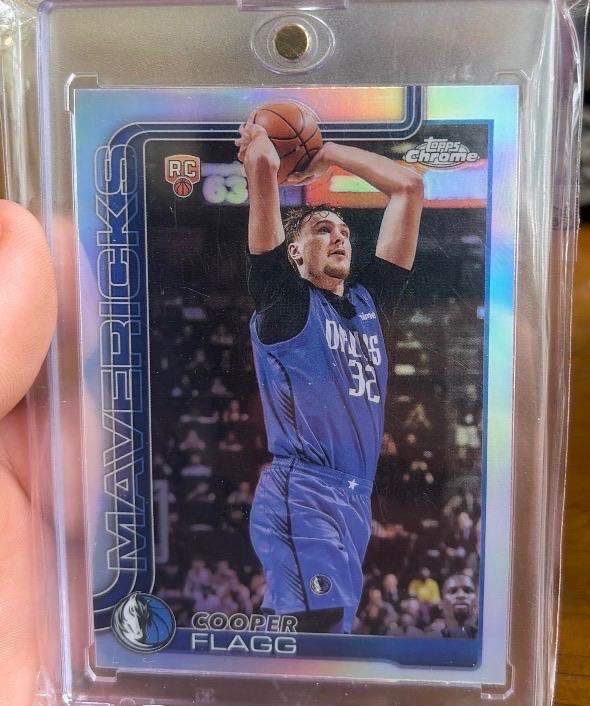
Dylan Harper. The Spurs took Harper second overall as the consensus number two player, and his card demand has tracked close behind Flagg's. Raw base and mid-tier refractors are projected in the tens of dollars, scaling into the hundreds for lower-numbered parallels and autographs. Watch centering on the numbered tiers, where Chrome's diffraction pattern can visually exaggerate a border that is only mildly off, so do not judge centering by eye alone before submitting.
Kon Knueppel. Knueppel's rookie season with Charlotte outperformed his draft slot, and his card values followed, with numbered Gold Refractor parallels and autographed cards already commanding real premiums. Base and mid-tier raw cards run in the single digits to tens of dollars; his numbered and autographed cards are the ones worth grading. Corners are the flag here, since heavy pack-to-hand traffic from collectors chasing the breakout story makes whitening the most common reason a Knueppel copy misses a 10.
VJ Edgecombe and Ace Bailey. Both landed in the top five and carry real rookie demand behind the top three names. Projected raw prices sit in the single digits to tens of dollars for base and low-tier parallels, climbing for autographed and numbered cards; treat these as directional until more sales post after August 6. Both are athletic, high-motion players with handling wear similar to Knueppel's, so the same corner-and-edge check applies before committing a grading fee.
Alter Egos, Minions NBA, and How Illustrated SSPs Grade
Chrome Update's two headline short prints are not photography-based, which changes how they need to be inspected. Alter Egos is the NBA's first release of its kind, a 10-card set reimagining each featured player as an illustrated, super-powered persona. Minions NBA is a five-card crossover with Illumination recasting NBA stars as Minions, the kind of pop-culture insert that pulls in buyers outside the core hobby. Neither has a confirmed print run or sales history yet, so treat any price you see before August 6 as speculative.
The grading behavior is not speculative, though. Illustrated art on chromium stock shows ink and color-block edges differently than a photo refractor: a hard color transition can look like a print line under raking light on a clean card, and a genuine surface scuff can just as easily hide inside a busy illustrated background. Scan these at multiple angles before deciding a mark is real, and do not assume an illustrated SSP grades like the photo refractor next to it in the same pack.
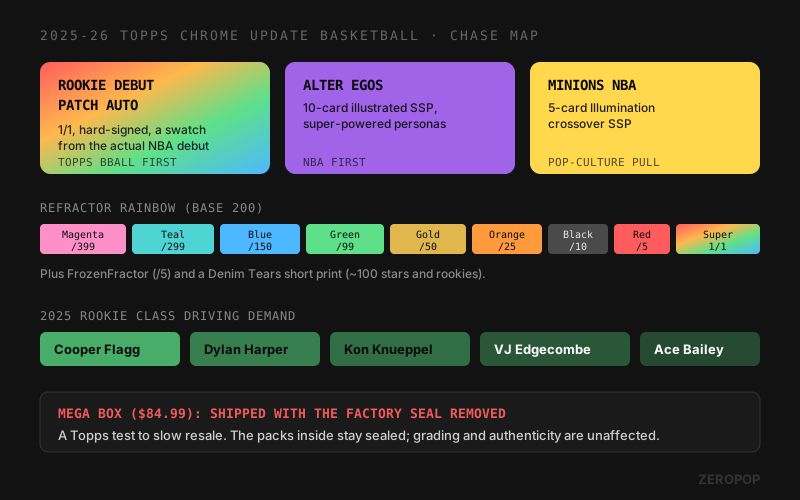
The top of the checklist belongs to the Rookie Debut Patch Autographs, arriving in Topps Basketball for the first time: hard-signed, numbered to 1-of-1, built around a patch cut from the jersey a rookie wore in his NBA debut game. Cooper Flagg's version is already being discussed alongside Paul Skenes' MLB Debut Patch, which sold for more than a million dollars after Skenes' rookie season; Flagg's has not sold, so any figure attached to it is speculation. At that scarcity, condition documentation matters more than a formal submission, and a careful scan first is the move.
Free · No account
Grade your first card free.
No account, no download, no waiting. Photograph the front and the back and get the overall grade back in about a minute.
or get the app


The Seal-Removal Policy: What It Means for Buyers
The news attached to today's mega box drop is not a card, it is packaging. Topps confirmed it will ship this presale's mega boxes with the factory shrink wrap fully removed, a policy it is testing because Tuesday's earlier presale for the same product moved fast enough that boxes started showing up relisted on eBay above retail within hours, and Topps cited "unprecedented demand" as the reason.
Removing the seal does not touch the product. The cards and packs inside are untouched and still factory-sealed at the pack level; only the outer box wrap is gone, an initial test Topps has not said it will expand. A mega box arriving without its wrap is not a sign of tampering, it is the intended condition for this batch; if buying secondhand, ask whether it is from this seal-removed batch before assuming something went wrong.
For graded singles, the seal policy has no bearing on authenticity or grading outcomes. PSA, BGS, and CGC grade the card in hand, not the box it came from, so a Debut Patch Auto pulled from a seal-removed mega box grades exactly the same as one from a shrink-wrapped hobby box. This is a resale story, not a condition story, and treating it as more when deciding whether to submit is a mistake worth avoiding.
Grading Chrome Basketball: Why Refractors and Patch Autos Cap a PSA 10 Differently
Chromium-coated cardstock fails differently than paper, and Chrome Update inherits every one of those quirks from its flagship sibling, the same profile 2026 Topps Chrome Baseball shares on the diamond.
Surface is the dominant risk, not centering. The reflective coating shows scuffs, fingerprint oils, and hairline scratches a matte paper card simply hides. A refractor that looks pack-fresh under room light can reveal a web of micro scratches under raking light, and those marks show up the same on a numbered parallel as on unnumbered base. Check every pull at more than one light angle before deciding it is a grading candidate.
Edges chip more visibly on chrome than on paper. The chromium layer is thin and brittle at the cut edge compared to a paper card's fibrous edge, so factory-cut nicks and pack-wear chipping show up as bright white breaks against the refractor finish, a real defect rather than a lighting trick. It is worth a full four-edge check, not just a glance at the corners.
Patch autos add a corner-and-window risk photo cards do not have. The physical patch window on a Rookie Debut Patch Autograph introduces a fabric swatch inside the card stock, and the corners around that window are more prone to lifting or soft bends. Inspect those four corners specifically before assuming a patch auto is grade-ready.
Centering still matters on the colored refractor tiers. The diffraction pattern on Blue, Green, Gold, and scarcer refractors shifts depending on where the card sits relative to its border, making off-center refractors easier to spot by eye, even though PSA measures to the printed border the same way regardless of finish.
Print lines are the false-positive risk. A faint line can be a genuine defect or a trick of chromium reflecting studio light at a bad angle. Rotate the card through at least three light angles before calling a print line real, particularly on the Alter Egos and Minions art cards. For the full four-axis breakdown, see is my card worth grading; for how the grading companies weigh refractor stock differently, see PSA vs BGS vs CGC.
What to Grade and What to Flip
Grade numbered rookie refractors and autographs from the top five names if the surface passes. A Flagg, Harper, Knueppel, Edgecombe, or Bailey card on a numbered parallel or signed rookie carries real scarcity on top of class demand, which supports a submission fee. Scan the surface and any patch-window corners first; if both come back clean, run the numbers with how to price a trading card before committing.
Treat unnumbered base rookies as a hold-or-flip call, not an automatic grade. They behave like base cards in supply terms, and the PSA 10 population on a hyped class builds quickly once a set is months into circulation, compressing the premium fast. Run the break-even math from best cards to grade in 2026 before paying a submission fee on anything unnumbered.
Debut Patch Autographs and Alter Egos SSPs are a documentation call, not a formula. At 1-of-1 scarcity, or on a short print with no comps yet, the standard grade-versus-flip math does not apply. Scan thoroughly, keep condition notes, and get a second opinion before submitting or holding raw, especially on a debut-night patch that cannot be replaced.
Watch how Chrome Update trades against the original 2025-26 Topps Chrome release. This is the same class' second Chrome product this season, so early community scan data on which cards pull clean versus rough will show faster than sales listings whether Update is a real second chase or a discount copy.
Frequently Asked Questions
When does the 2025-26 Topps Chrome Update Basketball mega box release?
The mega box presale opened today, July 10, 2026, at $84.99, ahead of the full release on August 6, 2026. Mega boxes ship with the factory plastic seal removed as part of a Topps test to slow immediate resale.
What are Rookie Debut Patch Autographs?
Hard-signed 1-of-1 cards built around a patch cut from the jersey a rookie wore during his NBA debut game, making their Topps Basketball debut. Cooper Flagg's version is the most talked-about, with collectors drawing comparisons to Paul Skenes' seven-figure MLB Debut Patch, though Flagg's card has not sold and any price attached to it is speculation.
Why did Topps remove the factory seal from the mega box?
Topps is testing the removal after "unprecedented demand" on an earlier presale led to boxes being relisted on eBay above retail within hours of the order window closing. Only the outer shrink wrap is affected; the cards and packs inside remain factory-sealed, and Topps calls this an initial test, not a permanent change.
What is the biggest rookie chase in this set?
Cooper Flagg, the number one overall pick and reigning Rookie of the Year, leads the class, followed closely by Dylan Harper and Kon Knueppel. VJ Edgecombe and Ace Bailey round out the top tier, with numbered refractors and autographs commanding the strongest premiums across all five.
How does Chrome Update grade differently than a paper flagship card?
Chromium-coated stock makes surface condition, not centering, the biggest PSA 10 risk, since the reflective coating shows scuffs and hairline scratches matte paper hides. Edges also chip more visibly on chrome because the coating is thinner at the cut edge, and patch autographs add a corner risk around the physical patch window that flat photo cards do not have.
Should I grade an unnumbered base rookie card from this set?
Usually only after running the break-even math. Unnumbered refractor rookies behave like base cards in supply terms, and the PSA 10 population on a hyped class tends to build quickly in the months after release, compressing the grading premium. Numbered parallels and autographed cards from the top five names carry a much stronger case for grading because of the added print-run scarcity.
As an eBay Partner Network affiliate, ZeroPop may earn a commission when you buy through eBay links on this page.
Written by
Marcus ReevesLead Grading Editor, ZeroPop
Marcus has been collecting and grading trading cards since the late 1990s, with a focus on Pokemon, vintage baseball, and modern basketball. He leads ZeroPop's grading research, runs the editorial team's PSA, BGS, and CGC submission tests, and writes the cost and turnaround tracking that powers the app's ROI calculator.
Free · No account
Know your grade before you submit.
ZeroPop scans your cards and gives instant sub-grades for corners, edges, surface, and centering. PSA, BGS, and CGC estimates included. Free to start.
or get the app
Keep reading
2026 Topps Chrome Baseball: Chase Cards and Grading Guide
2026 Topps Chrome Baseball hits July 22 for its 30th anniversary, led by Gold Logoman relics and a stacked rookie autograph class. What to grade first.
Grading GuidesBest Cards to Grade in 2026: Top ROI Picks
The 12 cards most worth grading in 2026 across Pokémon, baseball, football, basketball, and MTG. Ranked by PSA 10 premium and grading-cost ROI.
Grading GuidesIs My Card Worth Grading? The Decision Framework
A practical framework for deciding whether to grade your cards. Covers the break-even math, common traps, and the AI pre-grading approach.
Grading Company ComparisonsPSA vs BGS vs CGC vs SGC: 2026 Grading Comparison
An honest, detailed comparison of every major card grading company (PSA, BGS, CGC, and SGC) covering cost, speed, and market value.
Grading Costs & PricingHow to Price a Trading Card in 2026: Real Comps
The 2026 guide to pricing a trading card. eBay sold comps, TCGPlayer Market vs Median, slab premiums, pop-report math, and which free tools actually tell the truth.