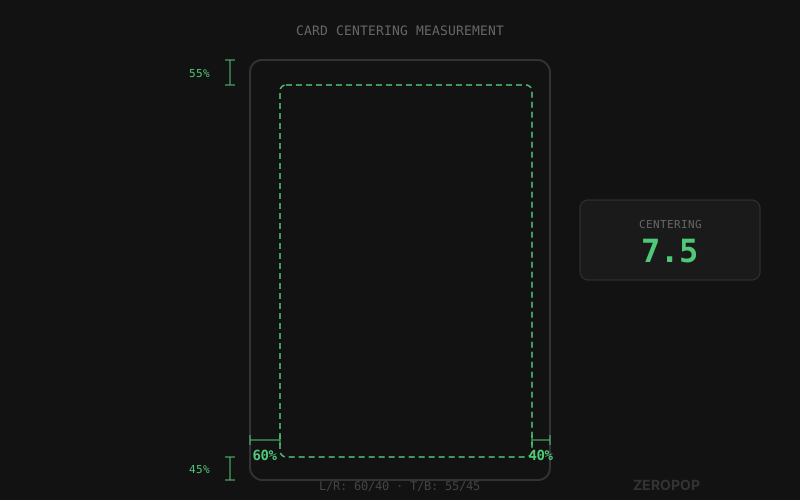
Card Centering Explained: The Axis That Decides Your Grade
Centering is the single most common reason a card that looks perfect to the naked eye comes back a 9 instead of a 10. Corners, edges, and surface reward a clean copy and forgive small flaws unevenly, but centering is a hard ratio measured with a loupe and a ruler, and there is no talking your way around a border that runs 65/35. This guide covers how PSA, BGS, and CGC actually measure centering, why the back of the card trips up more submissions than the front, and how to check your own cards before you pay a grading fee.
What Centering Actually Measures
Centering compares the width of the card's border on opposite sides of the printed image. A card measured at 60/40 has one border taking up 60 percent of the total border width on that axis and the opposite border the remaining 40 percent. Every card gets measured on two axes, left to right and top to bottom, and both axes get checked on the front and the back.
A card can look dead center to the eye and still measure 58/42 once someone puts a loupe on it, because human vision is bad at judging small differences in border width, especially on a card with a busy border pattern or foil texture that breaks up the edge. That gap between "looks fine" and "measures fine" is exactly why centering causes more surprise low grades than any other axis, and why our card grading scale guide treats it as its own line item rather than folding it into general condition.
How PSA, BGS, and CGC Grade Centering Differently
The three major companies do not use the same tolerances, and the gap between them is wide enough that the same physical card can pick up a different grade depending on where you send it. These numbers are the widely cited community-documented standards each company grades against, not a number any of the three publishes as a strict legal contract, but they are consistent enough across large sample sets to plan around.
| Grade | PSA | BGS | CGC |
|---|---|---|---|
| Gem Mint 10 (front) | 55/45 or better | 55/45 or better (Gem 9.5) | 50/50 |
| Gem Mint 10 (back) | 75/25 or better | 60/40 or better (Gem 9.5) | 60/40 or better |
| Black Label / Pristine 10 | not offered at this tier | 50/50 both sides | 50/50 front, 60/40 back |
| Grade 9 (front) | 60/40 to 65/35 | 65/35 or better | 60/40 or better |
PSA is the most forgiving of the three on the back of the card, which is why a copy with a slightly off back but a clean front can still land a PSA 10 when the same card would cap out at a BGS 9.5. BGS is the strictest overall once you chase its top Black Label tier, because 50/50 on both sides of both axes is a genuinely rare print result. CGC sits in between, closer to BGS on the front but with a back tolerance close to PSA's. None of this is marketing. It comes from measuring large numbers of graded population copies and reverse-engineering the cutoffs, which is also why you will see slightly different numbers quoted from site to site. Treat the table as a planning tool, not a guarantee on any single card.
See our full PSA vs BGS vs CGC comparison for how centering tolerance interacts with the rest of each company's scale, and BGS sub-grades explained for how a centering number rolls into Beckett's overall grade math.
Front and Back Both Count, and the Back Trips People Up
Collectors obsess over the front border because it is the side they look at, but every major grader checks the back too, and the back is where clean-looking submissions quietly lose a grade. Modern cards print the back design identically across an entire set, which means back centering is a pure manufacturing outcome. You cannot pick a well-centered back the way you can sometimes cherry-pick a well-centered front from a fresh pack, because packs do not sort by back centering and most collectors never think to check it before submission.
PSA's back tolerance is the most forgiving of the big three, 75/25 for a Gem Mint 10, which is part of why PSA's Gem Mint rate on modern sets tends to run higher than BGS's Black Label rate on the same set. BGS and CGC both hold the back closer to 60/40, so a card destined for either company needs a back that is actually centered, not just a front that looks great in hand. If you are choosing between companies for a specific card, check the back before you decide where to send it.
Free · No account
Grade your first card free.
No account, no download, no waiting. Photograph the front and the back and get all four sub-grades back in about a minute.
or get the app


How to Check Centering at Home Before You Submit
You do not need professional equipment to get a useful centering read before you pay a submission fee.
The ruler-and-loupe method. Lay the card face up on a flat surface, use a clear ruler or a printed centering guide, and measure the border width on all four sides in millimeters. Divide the larger measurement by the total width of both borders on that axis to get your ratio. This works, but it is slow, easy to misread on a busy border pattern, and needs to be repeated for the back.
A phone centering app or overlay tool. Several free tools let you photograph a card against a template and get an estimated ratio without a physical ruler. These are faster than manual measuring but only as accurate as the photo alignment, and most only check the front.
A scan-based grading app. This is the approach we built ZeroPop around: the app's centering analyzer measures both axes on both sides from your photos and returns a specific ratio alongside the corner, edge, and surface reads, so you see the exact number that would sink or save the card before you spend a submission fee finding out the hard way. It will not replace the eye of a PSA grader on a borderline call, but it turns "looks pretty centered" into an actual measurement in under a minute, which is the whole point of scanning before you submit. Read our AI vs human grading breakdown for where a scan is directionally reliable and where a human grader still has the final word.
Whichever method you use, measure before you decide a card is submission-worthy, not after the slab comes back. Our is your card worth grading framework walks through the full break-even math once you have a real centering number in hand instead of a guess.
Why Certain Sets and Print Runs Struggle More With Centering
Centering is a print-line problem before it is a grading problem, and some product categories run worse than others by design.
Foil and holo cards. The foil layer refracts light unevenly across the border, which makes a genuinely centered card look off to the eye and, in some print runs, actually shifts during the foiling pass in a way plain cardstock does not. Pokemon's full art and secondary illustration rares are consistently harder to center than the base-rarity cards in the same set for exactly this reason.
Black-bordered cards. A black border shows any shift far more obviously than a white or light-colored border, because the eye has nothing to anchor on inside a uniform dark frame. Vintage Yu-Gi-Oh, some Magic border treatments, and black-bordered Pokemon promos all see centering complaints out of proportion to their actual print quality.
Vintage cards generally. Print registration in the 1970s through 1990s was looser across every major sport and game, so a genuinely well-preserved vintage card frequently caps at a 7 or 8 purely on centering, with corners, edges, and surface all grading higher. This is normal for the era and not a sign of a bad copy.
High-volume modern print runs. A set that prints tens of millions of copies has more total variance simply because there are more copies to sample from, so both exceptional 50/50 copies and genuinely bad 70/30 copies exist in the same box more often than in a lower-print vintage set.
The ZeroPop Verdict on Centering
Centering is the one axis where a guess costs real money, because it is the one axis with a hard, numeric standard behind it instead of a judgment call. A corner or a surface defect gives a grader room to weigh severity. A border that measures 68/32 does not, no matter how clean the rest of the card looks. That is exactly why it deserves its own check before you commit a submission fee, not a glance under a lamp. Measure the front and the back, know which company's tolerance actually fits your specific card, and only then decide if the fee is worth paying.
Frequently Asked Questions
What is a good centering ratio for a PSA 10?
PSA's widely documented standard calls for 55/45 or better on the front and 75/25 or better on the back. A card at 60/40 on the front will typically cap at a PSA 9 regardless of how clean its corners, edges, and surface grade out.
Why is BGS stricter on centering than PSA?
BGS holds a tighter tolerance at its top tier, requiring close to 50/50 on both sides for a Black Label 10, versus PSA's 55/45 front allowance. This is one of the main reasons the same physical card can earn a PSA 10 while capping at a BGS 9.5, and it is a major factor in choosing which company to submit a specific card to.
Does the back of the card actually matter for centering?
Yes, and it catches more people off guard than the front does. Every major grader checks back centering as its own measurement, and because the back design is identical across an entire print run, a bad back is a manufacturing outcome you cannot cherry-pick around the way you sometimes can with a front border.
Can I measure my own card's centering accurately at home?
A ruler against a printed centering template gets you a real, usable number, though it is easy to misread on a busy or foil border. A scan-based grading app that measures both axes on both sides from a photo is faster and more consistent, and is the approach ZeroPop uses to return a specific centering ratio alongside the other three grading axes.
Why do foil and holo cards center worse than plain cards?
The foiling process applies an extra layer to the cardstock that can shift slightly during manufacturing, and the reflective surface itself makes a genuinely centered border harder to judge by eye. This is why secondary illustration rares and full art cards routinely show more centering variance than the base-rarity cards printed in the same set.
Is a centering issue ever worth grading around?
Sometimes. A card with a strong centering read but a minor corner or surface flaw can still land a high grade, since centering caps the ceiling rather than the whole card. But a card with a bad centering measurement has a hard ceiling regardless of how perfect everything else is, so it is rarely worth paying a full grading fee just to find that ceiling out the hard way.
Written by
Marcus ReevesLead Grading Editor, ZeroPop
Marcus has been collecting and grading trading cards since the late 1990s, with a focus on Pokemon, vintage baseball, and modern basketball. He leads ZeroPop's grading research, runs the editorial team's PSA, BGS, and CGC submission tests, and writes the cost and turnaround tracking that powers the app's ROI calculator.
Free · No account
Know your grade before you submit.
ZeroPop scans your cards and gives instant sub-grades for corners, edges, surface, and centering. PSA, BGS, and CGC estimates included. Free to start.
or get the app
Keep reading
Card Grading Scale: PSA 1 Through 10 Explained
Every grade on the PSA, BGS, and CGC scales broken down with real-world examples, qualifiers, and how sub-grades combine.
Grading Company ComparisonsPSA vs BGS vs CGC vs SGC: 2026 Grading Comparison
An honest, detailed comparison of every major card grading company (PSA, BGS, CGC, and SGC) covering cost, speed, and market value.
Grading GuidesBGS Sub-Grades: How Beckett Calculates the Final Grade
How BGS sub-grades for centering, corners, edges, and surface combine into a final grade. Including the BGS 9.5 Gem Mint and BGS 10 Pristine thresholds.
PokemonHow to Grade Pokemon Cards: The Complete 2026 Guide
Pokemon-specific grading guide covering holo types, centering issues, common defects, which cards to grade, and how to inspect at home.
Grading GuidesIs My Card Worth Grading? The Decision Framework
A practical framework for deciding whether to grade your cards. Covers the break-even math, common traps, and the AI pre-grading approach.
Grading GuidesPSA Grading Standards: How PSA Actually Grades Cards
The exact PSA grading standards used in 2026. Corners, edges, surface, centering tolerances at every grade from PSA 1 to PSA 10. Real examples and tolerances.